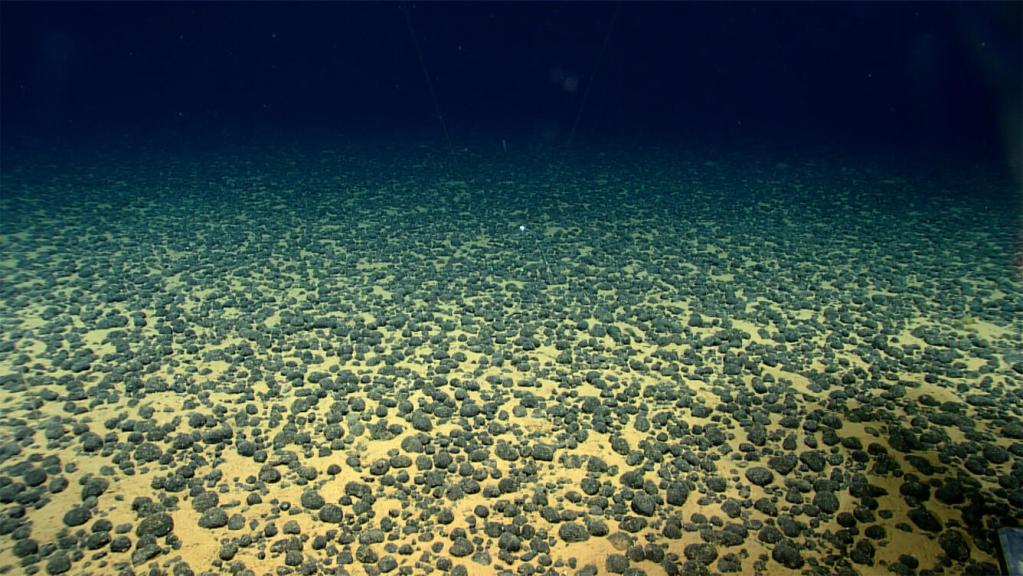
| This field of polymetallic nodules was seen during Dive 04 of the 2026 American Samoa ROV + Mapping Exploration expedition at a depth of approximately 5,140 meters (3.2 miles). Sediment scoops and push core samples were collected here for scientific assessment. By Isabel Cronin, PEN reporter |
On November 19th, the US Department of the Interior’s Marine Minerals Administration leased two tracts on the Outer Continental Shelf of American Samoa that advance the Trump Administration’s efforts to promote commercial off-shore mining.
The two twenty-year leases cover a combined 31.5 million acres on the American Samoa Outer Continental Shelf. They grant exclusive rights for preliminary seabed mapping and surveys, with an emphasis on polymetallic nodules and ferromanganese crust deposits. Further physical exploration and mining itself would require separate permits.
While two companies registered for the bid, only one ultimately participated. Both contracts went to Wetstone U.S. Ventures at the minimum price of three million dollars per tract, with a production royalty rate of 2 percent-for the first five years of production and 5% afterwards.
The auction marks the first step towards enabling commercial deep-sea mining operations and follows President Trump’s April 2025 Executive Order, “Unleashing America’s Offshore Critical Minerals and Resources.” The Executive Order highlighted the importance of increasing domestic access to critical minerals nickel, cobalt, copper, manganese, titanium, and rare earth elements vital for technology and energy security, and directed the Department of the Interior to establish an expedited process that, “consistent with applicable law, should ensure efficiency, predictability, and competitiveness for American companies.”
Local officials and indigenous leaders in American Samoa along with environmental organizations have filed several lawsuits to prevent the sale. During the public comment period, the Marine Minerals Administration received a total of 76,443 public comment submissions, a significant number of which opposed the sale, according to Finafinau, a youth-led environmental NGO. In 2024, American Samoa issued a moratorium on deep seabed mining in territorial waters, but this authority does not extend to the US federal EEZ of 200 nautical miles.
Just days before the sale, a federal judge in the U.S. District Court for the District of Hawaii ruled in favor of the plaintiffs, Fa’asao Amerika Samoa (FAS) and the Conservation Council for Hawai’i, represented by Earthjustice, who argued that the National Marine Fisheries Service had violated the Endangered Species Act. The court sided with the plaintiffs, finding that the environmental review did not sufficiently consider the longer-term implications of exploration and mining that could follow from the leases, but did not impede the auction from taking place.
Most recently, on November 18, Finafinau and the Natural Resources Defense Council filed yet another lawsuit. It argues that the Marine Minerals Administration’s surface-level environmental review violates the Administrative Procedure Act, the National Environmental Policy Act, the Outer Continental Shelf Lands Act, and the National Historic Preservation Act. According to a press release from the NRDC, the suit calls for the court to “strike down any leases executed pursuant to the unlawful lease sale.”
While deep-sea mining remains controversial, under international law of the sea, there are no explicit prohibitions. The US is not a party to the United Nations Convention on the Law of the Sea, and uses the 1980 Deep Seabed Hard Mineral Resources Act as the basis for regulation, licensing and expansion of commercial mining prospects down the line.
The Marine Minerals Administration, which was formed in July 2026 when Interior merged the Bureau of Ocean Energy Management and the Bureau of Safety and Environmental Enforcement, published a Proposed Leasing Notice for more than 69 million acres off the Commonwealth of the Northern Mariana Islands in August. It has also issued requests for information on seabed mineral leasing off the coasts of Alaska and Virginia.