


Tempe Mayor Corey Woods explains how federal funding from the Inflation Reduction Act and the Bipartisan Infrastructure Law are helping his city enact climate protection measures against deadly heat extremes. Left to right behind him are Kendra Flory, Co-Founder Broadmor Bike Bus, Christian Brock, CEO Elected Officials to Protect America, Paul Coseo, PHD Professor Arizona State University and Tempe Council Member Jennifer Adams. All praised the IRA and BIL for helping fund urban cooling infrastructure.
By Ramona du Houx
October 18, 2024
Tempe, Arizona. It’s October, yet extreme heat has been impacting Tempe, the state, and the southwest since summer. With extreme heat comes the risk of heat exhaustion, dehydration, and heat stroke — a potentially fatal condition that occurs when the body’s internal cooling mechanism begins to fail.
Tempe’s efforts to promote urban cooling and mitigate the climate crisis have drawn national attention. At the press conference Elected Officials to Protect America (EOPA) with the Climate Action Campaign congratulated Mayor Corey Woods, his team and local leaders for their work protecting Tempe from the dangers of the climate crisis and their proactive climate plans that are transforming Tempe into a sustainable city of the future. It was well noted that Tempe’s climate action plan and equitable climate goals are implemented with the help of federal funding from the Inflation Reduction Act (IRA) and Bipartisan Infrastructure Law (BIL).
Please listen to the recording of the press conference HERE
“Shade is a vital component for the infrastructure of cities exposed to extreme heat like Tempe. I’m honored and humbled to have had the opportunity to congratulate Mayor Corey Woods and local leadership for their climate actions. They have ensured the city’s climate action plan is protecting people from the dangers of excessive heat as the city advances clean energy deployment with climate resiliency. With weatherization homes and businesses owners will witness monthly utility costs go down while their quality of life goes up. Tempe is truly a model city for the southwest,” said Christian Brock, CEO of Elected Officials to Protect America, Air Force Veteran. The Inflation Reduction Act and Bipartisan Infrastructure Law are helping environmental equality happen on the road to a clean energy economy.”
Amongst other measures, Tempe is revolutionizing its infrastructure to support urban cooling, and safer streets, while transforming homes with weatherization to ensure residents are protected during days of extreme heat.
“Housing affordability is an issue Tempe has been tackling from all angles. We know with the added risk of extreme heat, utility bills skyrocket. We are doing everything we can to protect our vulnerable residents from extreme heat. Federal funding is critically helping our efforts. When we retrofit mobile homes with weatherization upgrades, lives will be saved, utility bills will go down and we will protect the environment by decreasing carbon emissions,” said Tempe Mayor Corey Woods. “Additionally, our tree canopy program will cool our city streets with expanded shaded areas and create jobs. And with a $12.5 million Department of Transportation grant, we are revolutionizing our infrastructure for nearly 4 miles of road into an urban-friendly street for pedestrians, bicycles, and vehicles.”
In addition to reducing pollution across the community, the IRA benefits residents most in need of cleaner air, with justice being a focus for the federal government. Tempe received an IRA Energy Efficiency Block Grant from the Department of Energy for $236,000 to weatherize mobile homes in three mobile home parks in the city.
This year has been the hottest on record worldwide.
“Tempe and the Phoenix metro area experienced the hottest summer on record. Summer 2024 broke last year’s previous record of 55 days over 110 degrees by 15 days, with 70 days over 110 degrees. With extreme heat comes degraded quality of life and the risk of life-threatening heat stress and illness,” said Paul Coseo, PHD Professor Arizona State University. “Our co-created heat action research supports Tempe as we’re working together to ensure everyone is healthy and safe by redesigning cooler urban landscapes. Federal funding from the Inflation Reduction Act and Bipartisan Infrastructure Bill helps turn these evidence-based heat action approaches for a more sustainable, resilient, and livable urban environment into a reality.”
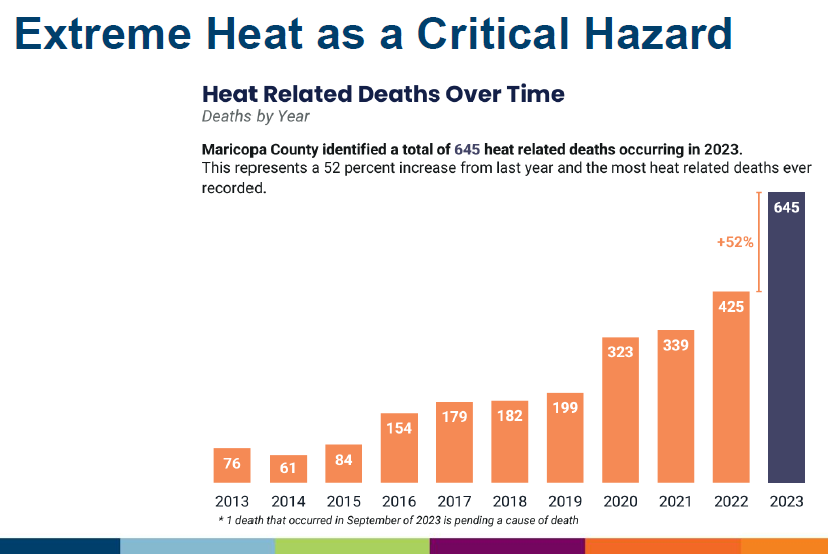
Heat is the leading weather-related cause of mortalities in the United States. Last year, 645 people in Maricopa County died from the heat, spiking from 425 in 2022.

Tempe received more than $12 million from the Bipartisan Infrastructure Law to transform the Baseline Road to a user friendly area for pedestrians, businesses and drivers with tree canopies and bike lanes.
The city’s high temperatures are exacerbated by the Urban Heat Island (UHI) effect, in which the cement and concrete absorbs heat in the day, trapping it. When night comes the city is prevented from cooling off which increases the intensity of the heat during peak hours. Fortunately, Tempe’s existing weatherization and emergency home repair programs are in demand. But tragically there were 156 indoor heat related deaths in Maricopa County.
A US Department of Agriculture Urban and Community Forest IRA grant was awarded to Tempe for more than $800,000 to establish a new residential focused program to provide education and resources, to support tree shade expansion.
“Tempe is a leader in sustainability with our comprehensive climate agenda that is transforming our city into an inclusive livable workable environment that combats extreme heat. We’ve successfully received Inflation Reduction Act and Bipartisan Infrastructure grants to help us lift up everyone so they can breathe cleaner air, no matter where they live,” said Tempe Council Member Jennifer Adams. “We are redesigning and retrofitting our workplaces and homes to be powered by renewable energy to lower our carbon emissions and utility bills, while improving our quality of life. By working together as a community, we will hit our goal of a 25 percent tree and shade canopy, which will cool our city and allow our children opportunities to be outside. It’s an honor to work with my colleagues on these issues, and we’re grateful to have the federal funds.”
Tempe’s unique initiatives are working in tandem to make the city a welcoming, safe environment for residents and businesses as their carbon footprint diminishes. The Boadmor Bike Bus is one. Community members wanted to protect children when they bike to and from school and other events. Kendra Flory and others got together and started the Bike Bus, which has children bike with adults in groups. This protects them as a cluster on roads verses being alone.
“Extreme heat affects families in many ways, including kids not being able to have recess outside for several months of the year. And for kids who need to bike and walk to school, it can be dangerously hot to do so. For those who want to bike, walk or use mobility devices to get around, lack of shade and lack of infrastructure prevents them from doing so. In too many places in Tempe, active transportation is scary and dangerous,” said Kendra Flory, Co-Founder Broadmor Bike Bus. “We need intentional projects like the work planned for Baseline Road that supports both safety and urban cooling. The Broadmor Bike Bus was started two years ago to advocate for solutions like this, and we are very happy to see this type of work being done in Tempe.”
The Inflation Reduction Act (IRA) provides over $369 billion in tax breaks, incentives, grants, and loan guarantees that will help mitigate the climate crisis which is devastating communities daily with weather extremes and bad air quality.
The Inflation Reduction Act (IRA) helps fight against the climate crisis as it reduces our carbon footprint while creating jobs. For Arizona that’s underway:
- Since the passage of the Inflation Reduction Act and the Bipartisan Infrastructure Law Arizona has seen more than $10 billion worth of investment in new clean energy projects, resulting in over 13,000 jobs.
- In 2021, there were already 59,383 Arizona workers employed in clean energy jobs. The Inflation Reduction Act will expand these opportunities, bringing an estimated $4.1 billion of investment in large-scale clean power generation and storage to Arizona until 2030.
- Manufacturers employ 180,800 workers in Arizona. The Inflation Reduction Act invests in the technologies of the future in the USA — supporting local economies and strengthening supply chains.
- A year ago, just south of Tempe, the American Battery Factory broke ground in Tucson on its new gigafactory that will manufacture lithium batteries and create 1,000 new jobs.
- Tempe-based First Solar expanded to Alabama and is constructing a $1.1 billion facility with IRA funds.