

Arizonans have the right to breathe clean air, drink clean water, and to be protected from extreme weather, say elected officials
September 22, 2025
By Ramona Cornell du Houx
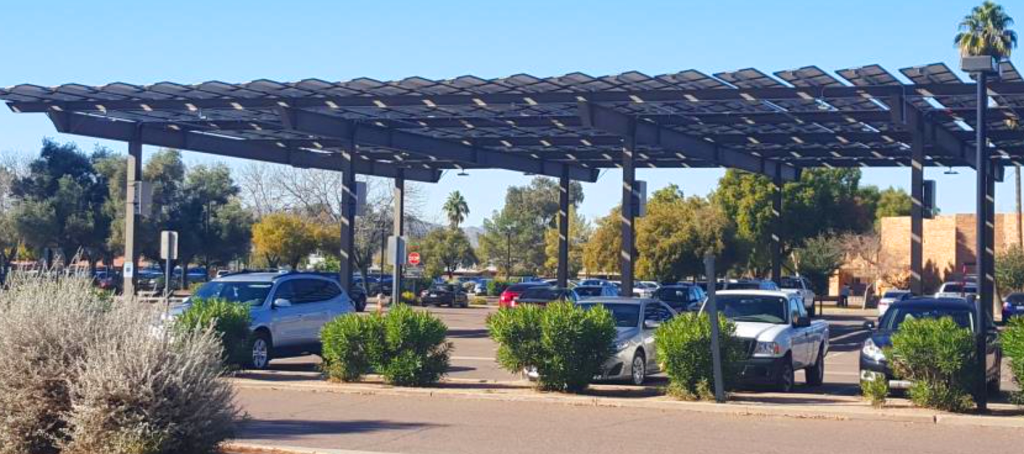
TEMPE, AZ. As fossil fuel-based energy continues to fuel the warming of the planet, extreme weather events are becoming frequent and fierce. At the Tempe Public Library complex, where solar arrays provide more than 70 percent of the complex’s power needs, Elected Officials to Protect America (E.O.P.A.) with the Climate Action Campaign (CAC) and VetsForward held a press conference to highlight measures that need to be taken to protect Arizonans.
Please see the recording of the event below:
From the mega drought to heatwaves, dust storms, wildfires, and torrential rains Arizona communities are on the frontlines of the climate crisis. The challenges Arizonans face require a fully funded, fully staffed, and politically independent federal response. However, the US President has declared he wants to end the National Oceanic and Atmospheric Administration (NOAA), the Federal Emergency Management Agency (FEMA), and even the Low-Income Home Energy Assistance Program (LIHEAP) and the Weatherization Assistance Program (WAP). His administration has stripped the Environmental Protection Agency (EPA) of its core mission. Attacks on these agencies threaten clean air, safe water, and climate pollution limits that protect public health.
“Thank you to Elected Officials to Protect America and the Climate Action Campaign for the work you’re doing to defend public health, protect our environment, and the fight for working families. Extreme heat kills more people every year than floods, hurricanes, and tornadoes combined. LIHEAP saves lives by keeping the AC running during deadly heat waves,” said US Arizona Senator Ruben Gallego, Veteran. “Instead of strengthening this program, this administration has gutted it, firing the staff who run it and trying to eliminate it in next year’s budget. That means fewer protections and less relief for the families who need it most. We need more investment in LIHEAP, not less. That is why I introduced the LIHEAP Parity Act, to ensure Arizona’s growing population receives its fair share of energy assistance because Arizona families deserve more support in the face of extreme heat.”
The solutions to achieve carbon neutrality and energy security depend on the deployment of more renewable energy, continued energy efficiencies and resilience measures. But actions by the current federal administration are holding back progress, while putting people and their communities at higher risk.

At the Tempe Library Arizona leaders called for federal action to restore clean energy funding and protect families from extreme heat and rising bills. From left to right: Aaron Márquez, State Representative, Legislative District 5; Major US Army Reserve, VetsFoward, Nancy Gutierrez, House Assistant Minority Leader; State Representative, Legislative District 18, Channel Powe, Former Balsz School District Boardmember, Christian Brock, Elected Officials to Protect America Senior Advisor, Air Force Veteran, Corey Woods, Tempe Mayor, Lauren Kuby, State Senator, Legislative District 8; Former Tempe Councilmember & Vice Mayor; ASU Senior Global Futures Scientist, Ricardo Reyes, Executive Director VetsForward, Marine Veteran and Jess White, Solar United Neighbors
“Arizona is on the frontlines of both clean energy innovation and deadly climate impacts. Tempe’s clean energy climate initiatives make the city a welcoming, safe environment for residents and businesses, by diminishing their carbon footprint. Tempe city leaders established a 100 percent clean energy goal by 2035, and worked with the federal government to secure needed grant funding for some clean energy projects. Sadly, that dynamic has changed,” said Christian Brock, Elected Officials to Protect America Senior Advisor, Air Force Veteran. “We are back to implore the federal government to fully fund and staff federal agencies that protect all Americans from extreme weather, and to release clean energy grant funding for more renewable energy projects for everyone in Arizona, like Solar for All. People need the security of knowing the federal government has their backs, especially in times of uncertainty due to climate crisis weather extremes.”
The Tempe library complex shows how solar is a natural fit for Arizona. However, a major $156,120,000 Solar-For-All grant was rescinded for Arizona, and other federally funded clean energy projects stopped by this administration. Now, Arizona will not be able to meet its clean energy goals, hurting families, and businesses. Marginalized communities will suffer the most.
E.O.P.A. with CAC were honored to be in Tempe a year ago to highlight how Tempe is an example for cities throughout the southwest.
The Tempe Public Library project includes roof solar panels, carport canopies that provide 262 shaded parking spaces, and a large solar canopy that is used as a community gathering space for festivals, events, and farmers markets, and solar protection panels for wheelchair access. This public solar project is truly a model example. Tempe’s library complex solar panels produce 1.3 million kWh of energy, which is equivalent to reducing carbon emissions by more than 900 metric tons and taking 190 vehicles off the road each year.
“The solar panels project at the library represents smart business and design. Not only is a clean and renewable power source fueling the library, we are also paying less for this power than a traditional power source. Thousands have enjoyed the solar panel shaded outdoor gathering place for neighborhood events,” said Corey Woods, Tempe Mayor. “Every summer we are experiencing far too many dangerously hot days. We know with the added risk of extreme heat, utility bills skyrocket. Federal funding from the Low-Income Home Energy Assistance Program and the Weatherization Assistance Program have been critical to help Arizona residents who live on fixed incomes. Every community across the state needs federal funding for clean energy initiatives, energy efficiencies and climate protection.”
The federal government’s biggest climate investments in history, the Inflation Reduction Act, created 900 new factories across America, representing 400,000 clean energy jobs. Just in one year, investments in manufacturing structures rose by a staggering 54 percent.
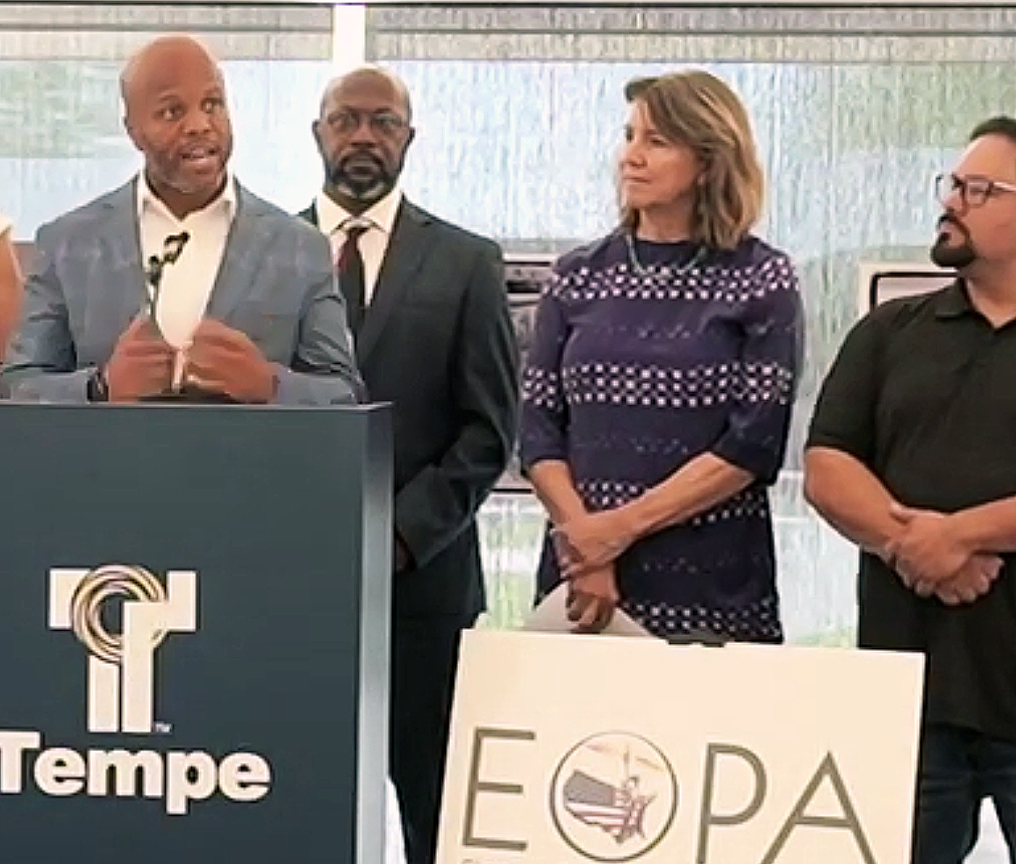
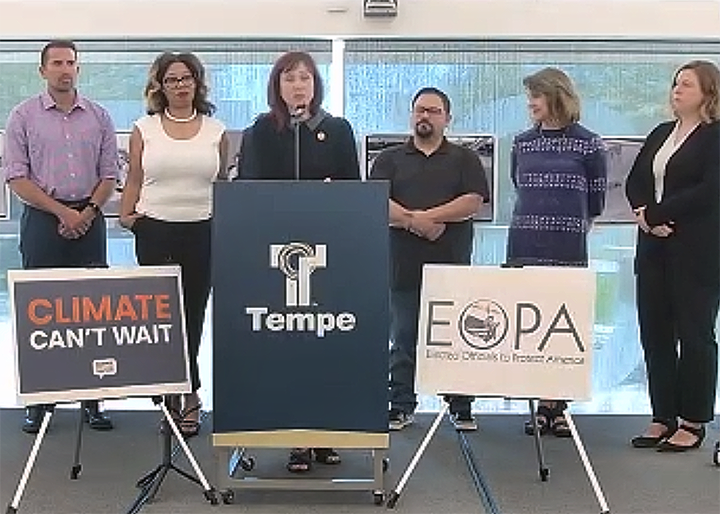
Left: Tempe Mayor Cory Woods speaks passionately about Tempe’s progress and the importance of continued federal clean energy grants. Right: Rep. Nancy Gutierrez talks as an educator about the struggles her students and others have because of extreme heat. One young girl passed out walking to school. The school system took action to bus even the closest students for safety.
“We fought to defend our democracy, our way of life. One where children and their families are secure knowing that federal policies protect them,” said Ricardo Reyes, Executive Director VetsForward, Marine Veteran. “Everyone deserves an equal opportunity to thrive in our great nation. That progress falters when we can not rely on the government ensuring clean air, and water. Laws that have brought investments in clean energy, have helped our economy and environment. They must continue.”
The nation’s first solar-powered cobalt processing facility will break ground next year in Yuma County. EVelution Energy expected to receive $42.5 million in subsidies under the Inflation Reduction Act. It’s one of two dozen projects catalyzed by the law that set aside close to $370 billion in tax breaks, incentives, grants, and loan guarantees designed to mitigate the climate crisis. which devastates communities daily with weather extremes and bad air quality, and reduce greenhouse gas emissions. .
“As an Army Veteran and State Representative we take an oath to the U.S. Constitution to serve and protect from threats foreign and domestic. The warming of the planet, because of greenhouse gas, results in direct threats to global security with mass migrations, and conflicts over scarce resources. The military knows the climate crisis is a threat multiplier,” said Aaron Márquez, Arizona State Representative (LD-5), Major U.S Army Reserve Veteran. “Arizonans have the right to a safe climate, to breathe clean air and drink clean water, and to be protected from the dangers of extreme weather. The lifesaving work of agencies such as the Environmental Protection Agency (EPA), the National Oceanic and Atmospheric Administration (NOAA), and the Federal Emergency Management Agency (FEMA), are our frontlines of defense. They must be fully funded and fully staffed. These actions, along with continued investments in clean energy, and sustainable infrastructure, will protect people and enable our nation to become energy secure.”
The Trump administration failed to recognize the climate crisis as a threat multiplier in their 2025 threat assessment, despite previously acknowledging the danger during Trump’s first term.
“Backtracking at the federal level has had cascading negative impacts across the U.S.—and Arizona, the sunniest state in the nation, is no exception,” said State Sen. (LD-8) and former Tempe Vice Mayor Lauren Kuby. “Arizona Public Service, our state’s largest monopoly utility, has walked away from its clean-energy commitment, pledging instead to burn coal until at least 2038. The Arizona Corporation Commission, which is supposed to regulate utilities in the public interest, followed suit—voting unanimously to begin to dismantle our renewable energy standard. They justify this retreat by pointing to growing energy demand from data centers, but willfully ignore the market reality that solar plus battery storage is now the cheapest electricity in history. Emboldened by federal rollbacks, APS and ACC have made reckless decisions that saddle Arizona families and future generations with rising utility bills, dirtier air, and a less stable climate.”
Public weather services and local health departments warn that heat is now the deadliest weather risk in Arizona, and that fact has both physical and mental health implications. Children with existing mental health conditions are at higher risk of experiencing increased symptoms during heatwaves.
“School is meant to be a safe haven where our children can thrive. As an educator, I know students need exercise and time outside. It’s bad mentally and physically to be stuck at a desk all day, but excessive heat limits physical activities. This significantly impacts students’ mental health by triggering stress responses, worsening anxiety and mood swings. Problem-solving becomes a challenge and test scores diminish with impaired cognitive functions,” said Assistant Minority Leader, State Rep. Nancy Gutierrez (LD-18). “Our children should not have to deal with this added stress, nor should their parents. When federal clean-energy investments are pulled back, it’s Arizona families who pay the price. The stress, polluted air, higher utility bills, and fewer outside local jobs are the result. On the other hand, clean energy investments save families money, bring cleaner air and can help mitigate weather extremes. We must do everything in our power to protect people from climate crisis dangers. That includes fully funding federal agencies that can help during extreme weather events for everyone’s protection. Every dollar stripped away from clean-energy programs is a dollar stolen from the prosperity, health and security of families.”
The Solar for All award was part of the historic $27 billion Greenhouse Gas Reduction Fund, developed under the Inflation Reduction Act to lower American families’ energy costs, create good-quality jobs in communities — including historically disadvantaged communities, advance environmental justice, and tackle the climate crisis.
“Working families and frontline communities bear the brunt of federal decisions that turn back progress for all. Finally, we had major Inflation Reduction Act climate investments that took environmental justice communities and their needs seriously. Now, those investment and critical environmental protections have been rolled back in favor of the fossil fuel corporations. It’s criminal,” said Channel Powe, former School Board Member, Balsz School District. “When clean-energy funding is rescinded, it’s not abstract — it means more children showing up to school with asthma, more elders struggling to survive in triple-digit heat, and more families forced to choose between keeping the lights on and putting food on the table. These are real lives, real health issues, and real economic pressures. Solar power and federal climate programs offer relief, resilience, and opportunity by lowering bills, improving public health, and creating good jobs. Arizona deserves a future where every community, regardless of zip code, can breathe clean air, drink clean water, stay safe in extreme heat, and thrive.”
Without the Solar for All program, eligible Arizonans will lose out on an average of 20 percent in annual energy bill savings per participating household, $11 million to support workforce development programs, and new solar deployment.
“Solar for All was a powerful investment in communities across the country, a concrete demonstration from the federal government that it hasn’t forgotten the individuals it represents. The proposed cancellation of these funds would hurt Arizona’s ability to deliver real relief to frontline folks struggling with rising utility bill costs in urban, rural, and Tribal communities,” said Jess White, Solar United Neighbors. “Beyond these benefits to everyday Arizonans, Solar for All was poised to strengthen our energy infrastructure when we needed it most. Just last month, the three largest utilities in Arizona saw record peak demands as residents cranked up the air conditioning during extreme heat. The program’s planned 61 megawatts of solar would have helped meet the state’s growing demand and prevent outages while creating quality jobs. Arizona is ready to lead the nation on solar energy, and our communities deserve access to affordable, accessible solar power.”
Solar United Neighbors has been helping people go solar for more than 15 years, and we will continue working to make solar accessible and affordable for everyone.
The Solar for All Arizonans program was based on using Arizona’s abundant solar resources to add affordable, reliable distributed electricity generation to the grid, creating $165 million in electricity bill savings and good-paying jobs around the state.