

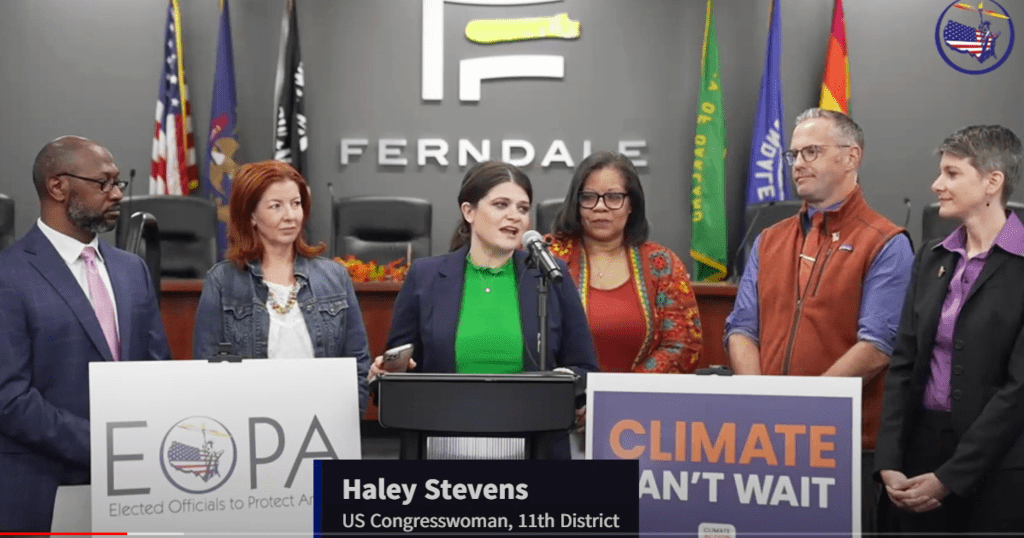
United States Congresswoman Haley Stevens, 11th District of Michigan, speaks at the EOPA/CAC press conference in Ferndale, MI. From left to right behind her: Christian Brock, CEO Elected Officials to Protect America, Former Mayor Melanie Piana, Mayor Raylon Leaks-May, Joseph Gacioch, ICMA-CM, Ferndale City Manager, Environmental Sustainability Commissioner Quinn Zeagler
Ferndale Highlights Potential Federal Climate Investments that Would Support Clean Energy Plans City
October 16, 2024
By Ramona du Houx
Ferndale, Michigan. The Inflation Reduction Act (IRA) provides over $369 billion in tax breaks, incentives, grants, and loan guarantees that will help mitigate the climate crisis which is devastating communities daily with weather extremes and bad air quality. The nation recently witnessed the veracity of two major hurricanes that were unleashed. Too many lost their livelihoods and prosperities. Far too many families lost a loved one. Michigan knows the impacts of climate change. Temperatures have risen steadily, the state has experienced torrential rains and unpredictable winters all of which have strained city budgets and endangered lives, prosperities and livelihoods.
The good news is — Ferndale has set the stage to embrace federal funding from the Inflation Reduction Act and Bipartisan Infrastructure Law to hold back the ravages of the climate crisis while growing the local economy with the city’s Climate Action Plan.
“A strong climate agenda is only as strong as the local elected officials. The tremendous leadership we see here in Ferndale every single day is a prime example of that. They are coming up with solutions every single day to the climate crisis,” said United States Congresswoman Haley Stevens, 11th District of Michigan. “We’re standing on the heels of the largest climate change funding act in history. With the Inflation Reduction Act and the Bipartisan Infrastructure Law their plans can become reality.”
At a Ferndale City Hall press conference Mayor Raylon Leaks-May joined US Congresswoman Haley Stevens and local leaders to showcase the city’s leadership in clean energy, sustainability, and climate action. Speakers discussed the different aspects of Ferndale’s climate actions as well as what the city plans for the future.
“In my tenure as Mayor, Ferndale was recognized multiple times – regionally, nationally, and globally – for our climate action efforts. I joined ICLEI’s Race to Zero, Climate Mayors, and the Global Covenant of Mayors for Climate and Energy; served as a panelist for the World Economic Forum on small-city climate change; and saw the City’s planning team launch an award-winning Climate Action Plan, said Former Ferndale Mayor Melanie Piana. “I’m incredibly proud of the work we accomplished, and I’m eager to see how Ferndale continues to serve as a benchmark for climate resiliency,
Please view the press conference HERE
Because of local leadership, Ferndale is well positioned to apply for IRA federal funding. Ferndale’s Climate Action Plan with equitable climate goals will be realized, and Justice40 areas will be uplifted as federal funding helps with costs many cities can’t afford on their own.
“Earlier this year, a local student asked me what Ferndale was doing to combat the climate crisis. This student is representative of so many others who see the impacts of the climate crisis and worry about the future. Our young people deserve everything we can do to make this world a cleaner, safer space, and we’re thrilled to benefit from the Inflation Reduction Act to help us make that happen,” said Ferndale Mayor Raylon Leaks-May.
No city can achieve the infrastructure changes needed to transition to a sustainable climate friendly city without substantial funding, which the federal government now can supply.
“I’m thrilled about the opportunities our residents will gain from Inflation Reduction Act tax credits. Folks can receive help for a number of sustainability improvements, from energy efficiency upgrades and renewable energy investments. For a city like Ferndale, which is committed to local climate action, this means we finally have the resources to make real, equitable change in our community,” said Joseph Gacioch, ICMA-CM, Ferndale City Manager.
The Home Efficiency Rebates Program (HOMES) is providing a nearly $106 million rebate program for households to make energy efficiency upgrades that range from $2,000 to $8,000 per household for low and moderate-income households.
On the manufacturing side as of May 2024,with Inflation Reduction Act funding Michigan has introduced 45 new clean energy projects, ranging from solar and EVs to hydrogen and batteries — the most across any state in the nation..
“We’re fortunate to have local elected leaders who have positioned Ferndale well for Inflation Reduction Act grants. Their leadership reflects our community’s commitment to combat the climate crisis,” said Quinn Zeagler, Ferndale Environmental Sustainability Commission Member. “We’re proud to be on the forefront of a clean energy economy where sustainability is the norm and everyone can enjoy clean air, water and land.”
Companies have already announced enough new U.S. battery manufacturing projects to support production of more than 10 million EVs per year. Building an EV fleet is important to Ferndale and supports the auto industry’s embrace of EVs.
“It’s exciting to understand the process that has led Ferndale to be in a position to apply for critical funding from the Inflation Reduction Act. With solar power, electric vehicle incentives and building retrofitting homeowners and businesses will not only become environmentally friendly, key monthly utility costs will go down while everyone’s quality of life goes up,” said Christian Brock, CEO of Elected Officials to Protect America, Air Force Veteran. “Everyone has the right to grow up in an energy secure America. We’re here to celebrate Ferndale’s commitment and commitment to environmental sustainability.”

The Inflation Reduction Act’s incentives and grants are critical to help communities with upfront costs. Importantly, the IRA is allocating 40 percent of its investments for Justice40 communities — improving environmental justice —bringing hope into communities historically neglected that are impacted by fossil fuel pollution and extreme weather the most. This is where the Inflation Reduction Act and Bipartisan Infrastructure Law are key components to a sustainable future for all.
According to a Treasury analysis, since the IRA passed, 75 percent of clean energy investments have been in counties with lower than median household incomes.
“Mayor Raylon Leaks-May and her team have positioned her city to apply for critical Inflation Reduction Act funding that will help meet Ferndale’s climate goals. IRA funds will reduce the city’s carbon footprint, create jobs, uplift Justice40 regions, and will improve the community’s health,” said Alex Cornell du Houx, former Maine State Representative, Marine combat veteran, President of the Elected Officials to Protect America, and Co-Founder. “The IRA has been the catalyst that is putting America on the road to a clean energy economy while growing family-sustaining jobs. “
Michigan is making progress in lowering carbon emissions that have caused the climate crisis.
- According to Climate Power Michigan is No. 1 in the nation for IRA projects, which have resulted in more than $25 billion in new investments across the state
- The state received $159 million in federal funding to help lower the cost of community and rooftop solar installations for thousands of low-income households. The funding comes from the Inflation Reduction Act’s Greenhouse Gas Reduction Fund and is administered through the MI Solar for All program.
- The 2023 Clean Jobs America Report stated that clean energy businesses in Michigan added more than 5,400 workers in 2022.
In addition to driving investments in clean energy manufacturing, the Inflation Reduction Act is lowering costs and bringing clean energy and climate solutions to homes and businesses across the state.
Other costs for Michigan households and businesses reduced through the IRA:
- High-Efficiency Electric Home Rebate Act (HEEHRA). A more than $105 million, 10-year rebate program to support low- and moderate-income (LMI) households who choose to invest in electric appliances.
- Climate Pollution Reduction Grants: A $3 million grant to engage Michigan residents statewide in the strategic implementation of the MI Healthy Climate Plan.
- National Electric Vehicle Infrastructure Program: $110 million Bipartisan Infrastructure Law program to create a statewide, interconnected network of DC fast chargers along the National Highway Systems.