

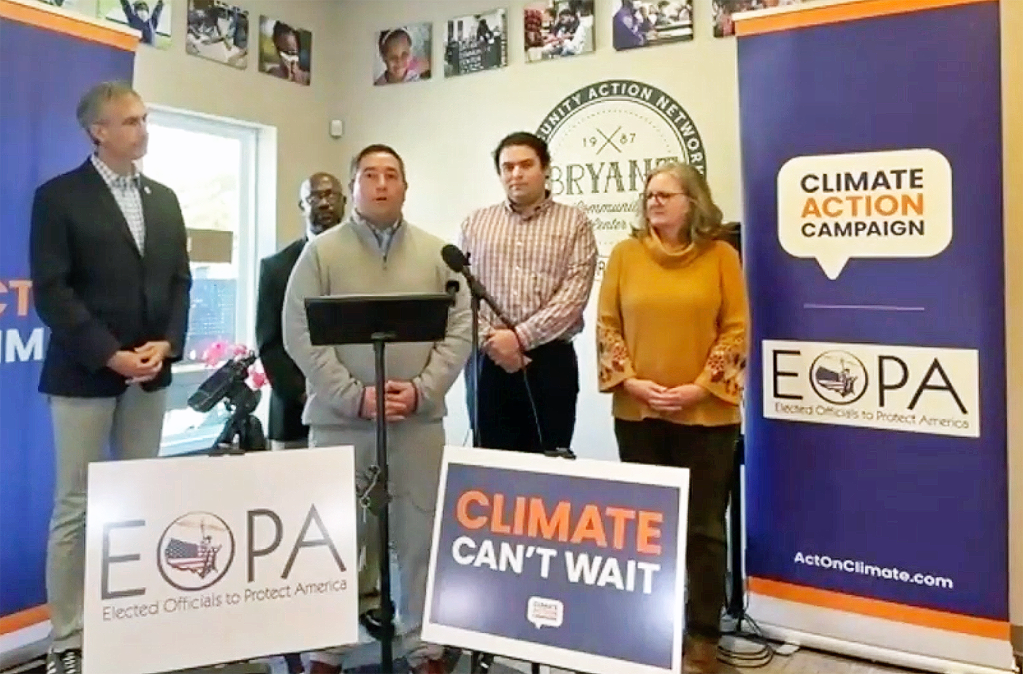
Derrick Miller, Executive Director of Community Action Network – Bryant Community Center speaks about how the Inflationaton Reduction Act and Bipartisan Infrastructure Law funding has helped transform the Center. The funding he said, “actually has saved lives.” Behind him from left to right: Ann Arbor Mayor Christopher Taylor, Christian Brock, CEO of Elected Officials to Protect America, Simi Barr, Office of Sustainability and Innovations and Jennifer Hall, Executive Director Ann Arbor Housing Commission
Ann Arbor is using Inflation Reduction Act grants to help transform the city to reach their equitable climate goals

By Ramona du Houx
October 22, 2024
ANN ARBOR, MI. Residents of Michigan know the impacts of climate change. Temperatures have risen steadily, the state has experienced torrential rains and unpredictable winters all of which have strained city budgets and endangered lives, properties and livelihoods.
The good news is — Ann Arbor has made a deep and sustained commitment to a just transition to community-wide carbon neutrality by 2030. Under the leadership of Mayor Christopher Taylor, the city has made tangible steps forward with federal funding from the Inflation Reduction Act (IRA) and Bipartisan Infrastructure Law (BIL) to achieve their climate goals.
Graphic: Ann Arbor has a comprehensive plan to power the city on Geothermal – which will lower costs for all.
“Thanks to the Biden-Harris administration, we’re making historic investments to fight the climate crisis, clean our air, protect public health and water, and improve our infrastructure. All of which will help Ann Arbor reach our climate goals on the road to a clean energy economy,” said Ann Arbor Mayor Christopher Taylor. “I am delighted to share our stories of success here at the Bryant Community Center and I marvel at its transformation into a sustainable energy center for everyone. The funds available through the Inflation Reduction Act and Bipartisan Infrastructure Law are making a tangible difference here in our city as we continue to build a brighter future for all.”
Please view press conference HERE.
At a press conference, hosted by Elected Officials to Protect America (EOPA) and the Climate Action Campaign (CAC) Mayor Christopher Taylor joined local leaders to showcase the city’s climate actions that are integrated holistically to work together as they transition to clean renewable energy. Speakers discussed the different aspects of Ann Arbor’s climate actions as well as what the city plans for the future. Ann Arbor’s equitable climate goals are being realized with federal funding from the IRA and BIL.
“We have come to the Bryant Community Center to celebrate Ann Arbor’s commitment to environmental sustainability and their determination to achieve environmental equality on the road to a clean energy economy. It was exciting to hear how Ann Arbor is using Inflation Reduction Act and Bipartisan Infrastructure Law federal funding with their comprehensive citywide plan of action to combat the ravages of the climate crisis. The Bryant Center is a shining example of Mayor Taylor and his community’s commitment to equity and equality through climate initiatives,” said Christian Brock, CEO of Elected Officials to Protect America, Air Force Veteran. “Everyone has the right to breathe fresh air, and grow up in an energy secure America. Those principles are the credo of Ann Arbor.”
The Inflation Reduction Act’s incentives and grants are critical to help communities with upfront costs. Ann Arbor was awarded $182,360 through a federal Energy Efficiency and Conservation Block Grant (EECBG) program to renovate the Bryant Community Center into a net-zero facility and living learning laboratory of climate action.
“As Executive Director of Community Action Network, I’ve seen firsthand how the Inflation Reduction Act’s sustainability initiatives are transforming the Bryant neighborhood. From energy-efficient upgrades to cleaner air, these efforts are not just improving homes — they’re empowering families and fostering a healthier, more resilient community for generations to come,” said Derrick Miller, Executive Director of Community Action Network – Bryant Community Center.
The city was the first city in Michigan, and the second in the Midwest, to receive this kind of grant from the Department of Energy EECBG program funded by the Bipartisan Infrastructure Law.

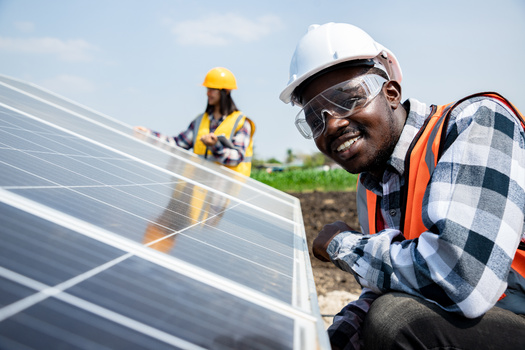
With solar power, electric vehicle incentives and building retrofitting, homeowners and businesses become more environmentally friendly, and everyone’s quality of life improves. The Inflation Reduction Act’s incentives and grants are critical to help communities with upfront costs.
“When budgets are tight, it is hard for low-income residents and non-profits to budget for unpredictable utility costs. Residents can be extremely conscientious about their energy usage, but they do not have control over how much they will be charged for their energy use. Therefore, anything we can do to help reduce consumption through energy efficiencies is beneficial,” said Jennifer Hall, Executive Director Ann Arbor Housing Commission. “Federal climate investments with grants and rebates are key components that will help residents transition to energy security.”
The plan to integrate all aspects of climate action is in the city’s A2ZERO program. Essentially it is an unique initiative to achieve a just transition to community-wide carbon neutrality. The IRA and BIL have assisted with A2ZERO initiatives.
“We’re excited by the historic federal investments that have been made in the effort to combat climate change. Legislation such as the Inflation Reduction Act and Bipartisan Infrastructure Law allowed funding to be unlocked for sustainability initiatives related to municipal operations, but also community-wide. These measures have led the City to make significant investments in renewable energy projects at City sites, with over 600 kW of new solar coming online in the past 18 months,” said Simi Barr, Office of Sustainability and Innovations.
With A2ZERO Ann Arbor has made substantial progress:
- The city has created the nation’s first fully carbon neutral existing neighborhood
- Installed Michigan’s first utility-pole EV chargers;
- Invested in resilience hubs and resilience infrastructure
- Deployed nearly 8 MW of rooftop solar throughout the city;
- Launched Michigan’s first commercial, multifamily and single-family energy disclosure ordinances.
The city of Ann Arbor also received $2.8 million to expand equitable access to public EV charging infrastructure amongst other measures.
“Mayor Christopher Taylor, his community and team have made Ann Arbor America’s Climate City. They already have secured substantial Inflation Reduction Act and Bipartisan Infrastructure Law funding to reach their climate goals. They are reducing the city’s carbon footprint, creating jobs, and improving community health with a just transition,” said Alex Cornell du Houx, former Maine State Representative, Marine combat veteran, President of the Elected Officials to Protect America, and Co-Founder. “The IRA is the catalyst that has put America on the road to a clean energy economy while growing family-sustaining jobs. Ann Arbor is showing the way.“
The Inflation Reduction Act (IRA) provides over $369 billion in tax breaks, incentives, grants, and loan guarantees that will help mitigate the climate crisis which is devastating communities daily with weather extremes and bad air quality. Michigan knows the impacts of climate change.
To assist in community health, amongst other measures the IRA offers:
- Climate Pollution Reduction Grants: A $3 million grant to engage Michigan residents statewide in the strategic implementation of the MI Healthy Climate Plan.
- National Electric Vehicle Infrastructure Program: $110 million Bipartisan Infrastructure Law program to create a statewide, interconnected network of DC fast chargers along the National Highway Systems.
Michigan is already making progress to lower carbon emissions that have caused the climate crisis.
- As of May 2024, utilizing Inflation Reduction Act funding, Michigan has introduced 45 new clean energy projects, ranging from solar and EVs to hydrogen and batteries — the most across any state in the nation.
- According to Climate Power Michigan is No. 1 in the nation for IRA projects, which have resulted in more than $25 billion in new investments across the state
- The state received $159 million in federal funding to help lower the cost of community and rooftop solar installations for thousands of low-income households. The funding comes from the Inflation Reduction Act’s Greenhouse Gas Reduction Fund and is administered through the MI Solar for All program.
- Companies have already announced enough new U.S. battery manufacturing projects to support production of more than 10 million EVs per year.
- The 2023 Clean Jobs America Report stated that clean energy businesses in Michigan added more than 5,400 workers in 2022.
Costs for Michigan households and businesses that will be reduced through the IRA: Michigan received $210.9 million for the Home Energy Rebate Programs. Of this, $105.7 million is allocated for the HEER and $105.2 million is allocated for HEAR.
- Home Efficiency Rebates Program: A nearly $106 million rebate program for households to make energy efficiency upgrades range from $2,000 to $8,000 per household for low and moderate-income households.
- High-Efficiency Electric Home Rebate Act. A more than $105 million, 10-year rebate program to support low- and moderate-income (LMI) households who choose to invest in electric appliances.