

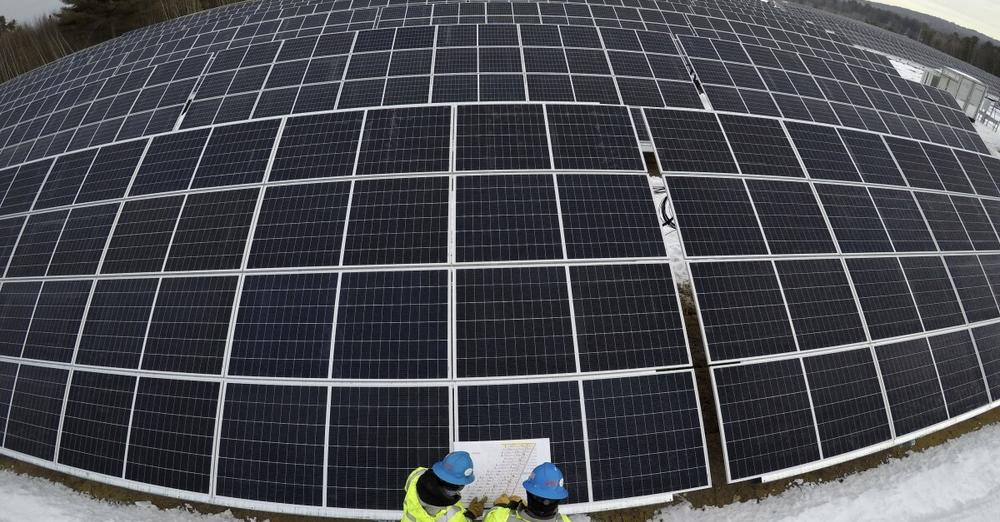
EPA announces 60 selectees under Greenhouse Gas Reduction Fund grant competition to deliver solar to more than 900,000 low-income and disadvantaged households nationwide through the Inflation Reduction Act
By Ramona Cornell du Houx
April 22, 2024
On Earth Day, April 22, the U.S. Environmental Protection Agency with President Biden announced 60 selectees that will receive $7 billion in grant awards through the Solar for All grant competition to deliver residential solar projects to over 900,000 households nationwide.
The solar grant competition is funded by President Biden’s Investing in America agenda through the Inflation Reduction Act, which created EPA’s $27 billion Greenhouse Gas Reduction Fund.
“These awards across the country are to states, territories, tribal governments, municipalities and non-profits to develop programs to enable low income and disadvantaged communities to benefit from residential solar power. It’s a big deal,” said President Joe Biden.
The 60 selections under the $7 billion Solar for All program will provide funds to states, territories, Tribal governments, municipalities, and nonprofits across the country to develop long-lasting solar programs that enable low-income and disadvantaged communities to deploy and benefit from distributed residential solar, lowering energy costs for families, creating good-quality jobs in communities that have been left behind, advancing environmental justice and tackling climate change.

President Biden also announced a new website to encourage citizens to join the American Climate Corps, a volunteer government organization modeled on former president Franklin Delano Roosevelt’s much-vaunted Civilian Conservation Corps of the 1930s. The site, climatecorps.gov, aims to initially fill about 2,000 positions across 36 states, Washington DC and Puerto Rico, hosted by organizations working on clean energy, conservation and climate resilience projects. Ultimately the corps will employ more than 20,000 young people.
Aimed mainly at young people, a press release said the program’s goal is, “to make it easy for any American to find work tackling the climate crisis while gaining the skills necessary for the clean energy and climate resilience workforce of the future.”
“Today is a historic day and a landmark achievement,” said New York Representative Alexandria Ocasio Cortez, who spoke at the event with President Biden. “It serves as a reminder of the power of organizing, of what we can accomplish when young people, climate advocates, labor organizers and working people come together to demand the future we all deserve.”
The Solar for All program also advances President Biden’s Justice40 Initiative, which set the goal that 40 percent of the overall benefits of certain federal climate, clean energy, affordable and sustainable housing, and other investments flow to disadvantaged communities that are marginalized by underinvestment and overburdened by pollution. All of the funds awarded through the Solar for All program will be invested in low-income and disadvantaged communities.
“Solar is the cheapest form of electricity—and one of the best ways to lower energy costs for American families,” said John Podesta, Senior Advisor to the President for International Climate Policy. “Today’s announcement of EPA’s Solar for All awards will mean that low-income communities, and not just well-off communities, will feel the cost-saving benefits of solar thanks to this investment.”
EPA estimates that the 60 Solar for All recipients will enable over 900,000 households in low-income and disadvantaged communities to deploy and benefit from distributed solar energy. This $7 billion investment will generate over $350 million in annual savings on electric bills for overburdened households.
“The United States can and must lead the world in transforming our energy systems away from fossil fuels,” said U.S. Senator Bernie Sanders (VT). “The Solar for All program – legislation that I successfully introduced – will not only combat the existential threat of climate change by making solar energy available to working class families, it will also substantially lower the electric bills of Americans and create thousands of good-paying jobs. This is a win for the environment, a win for consumers, and a win for the economy.”
The program will reduce 30 million metric tons of carbon dioxide equivalent emissions cumulatively, from over four gigawatts of solar energy capacity unlocked for low-income communities over five years. Solar and distributed energy resources help improve electric grid reliability and climate resilience, which is especially important in disadvantaged communities that have long been underserved.
At least 35 percent of selected applicants have already engaged local or national unions, demonstrating how these programs will contribute to the foundation of a clean energy economy built on strong labor standards and inclusive economic opportunity for all American communities.
The 60 selected applicants will serve households in all 50 states, the District of Columbia, Puerto Rico, and territories, as well as increase access to solar for Tribes.
In at least 25 states and territories nationwide, Solar for All is launching new programs where there has never been a substantial low-income solar program before.

In these geographies, Solar for All selected applicants will open new markets for distributed solar by funding new programs that provide grants and low-cost financing for low-income, residential solar.
Examples:
- The threat of storms is a major reason Athens, Georgia resident Delmira Jennings and her husband John used selected applicant Capital Good Fund’s Georgia BRIGHT leasing program to install a 13-kilowatt solar and 10-kilowatt-hour battery system in February. “Last year, we spent two days without power after what seemed like a mini tornado,” Jennings said. After a recent outage, Jennings noted that she didn’t even know she lost power. “The batteries kicked in and all the power items we were using were on battery backup.”
- Last year, the Northern Cheyenne Tribe, whose successful pilot initiative served as the basis for selected applicant Mandan, Hidatsa, Arikara (MHA) Nation’s Northern Plains Tribal Solar for All program, took major steps toward a clean energy future with the completion of the first phase of the White River Community Solar project. This project will deploy 15 solar systems at the homes of elders while piloting a groundbreaking approach to solar ownership and management that is intended to set an example for Tribes across the nation.
- Through its existing Solar on Multifamily Affordable Housing (SOMAH) program — a model for equitably providing solar to low-income renters in disadvantaged communities — selected applicant GRID Alternatives’ team in San Diego installed a solar energy system at Trolley Trestle, home to youth transitioning out of the foster care system. Energy cost savings estimated at over $600k over ten years, will be reinvested to provide additional services to those who call Trolley Trestle home, including more job and life skills training.
Informational Webinars
EPA will host informational webinars as part of the program’s commitment to public transparency. EPA has scheduled a public webinar for the Solar for All program, and registration details are included below. Information on other GGRF webinars can be found on EPA’s Greenhouse Gas Reduction Fund Engagement Opportunities webpage.
- Solar for All webinar: Monday, April 29, 2024, 4:00pm – 4:30pm ET. Register for the April 29 meeting