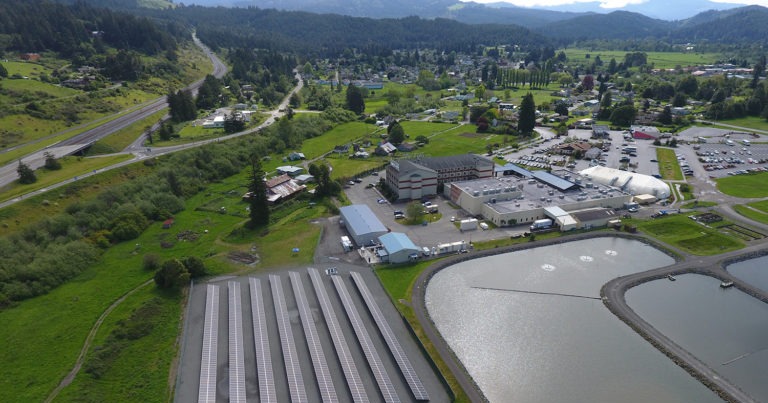
The microgrid at Blue Lake Rancheria generates renewable energy and provides about $150,000 in annual electricity savings. (Schatz Energy Resource Center)
Listen to the story HERE
By Suzanne Potter
Mar 23, 2026
Microgrids can be a lifeline in remote rural areas prone to power outages, according to local and tribal leaders in Humboldt County.
North Coast leaders spoke out at an event on energy security in an era of wildfire, drought and sea-level rise, all linked to climate change.
Arne Jacobson, director of the Schatz Energy Research Center at California State Polytechnic University-Humboldt, said microgrids often involve solar panels plus battery storage.
“During normal operation, they’re connected to the regional grid and they can export power and generate revenue,” Jacobson explained. “During a regional grid outage, they operate in ‘island mode’ and can provide resilience energy services.”
Microgrids have gained popularity in recent years as utilities have had to shut off power intermittently during wildfires and high wind events. Jacobson added the Willow Creek and Hoopa substations and their associated circuits in the Humboldt area are frequently on the top 10 list of least reliable circuits in the state.
Elizabeth Burks, executive director of the Redwood Coast Energy Authority, said its microgrid serves as backup power to the airport and kept it online for 15 hours in December 2022, when an earthquake knocked out power to 70,000 customers.
“We’re all familiar with how important it is to keep the airport going,” Burks noted. “We do emergency medical transport out of there and the Coast Guard serves 250 miles of search-and-rescue territory. And again, we can keep them going when we go into ‘slanding.'”
“Islanding” is the term for a system which can kick in and power a local area when the main utility grid goes down.
Heidi Moore-Guynup, director of tribal and government affairs for the Blue Lake Rancheria Tribe, said its microgrid saved the day during the 2022 blackout, keeping several tribal buildings running so they could provide ice, gas, medical care and lodging.
“We want to be known as the safe place to go, the islands in times of despair,” Moore-Guynup emphasized. “We are a very small rural community, but we are engaged in technological advances that can help rural global energy access.”