

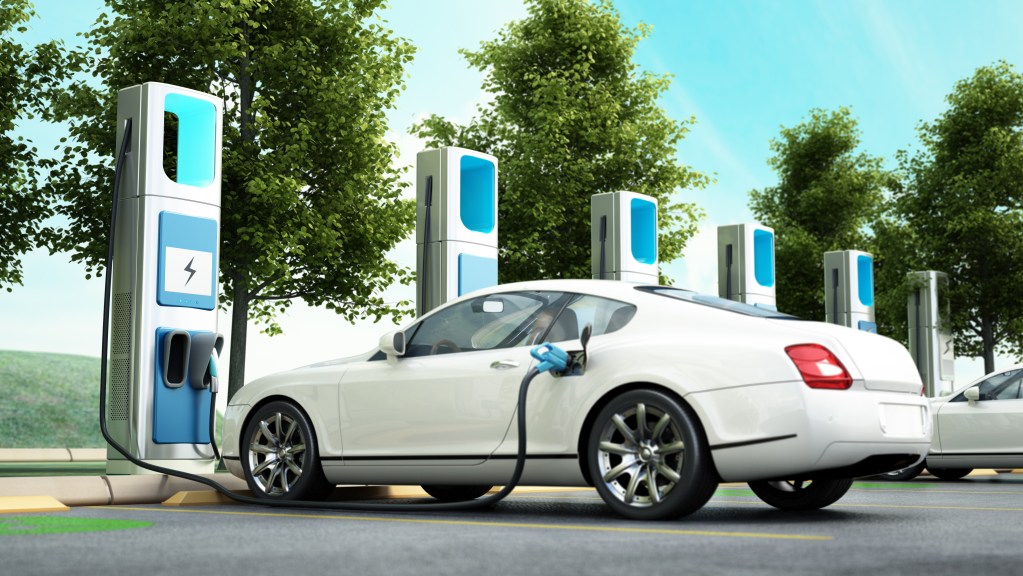
Plug‑in EVs made up about 9.6% of all new light‑duty vehicle sales in the first quarter of 2025, down slightly from 10.9% in the fourth quarter of 2024, yet still showed a 9% year‑over‑year increase in volume to roughly 375,000 units. (Destina/Adobe Stock)
Listen to the story HERE
By Chrystal Blair
Jul 30, 2025
As Michigan works to hold its place in the electric vehicle market, clean energy advocates said more investment is urgently needed.
Lawmakers and supports at a press event, part of the national Freedom to Drive Electric tour in Lansing’s Ranney Park, warned without action, the state could fall behind the global competition. Michigan currently builds six electric vehicle models and has drawn more than $20 billion in investment, supporting 34,000 jobs.
Gabrielle Lawrence, an Ingham County Commissioner, said at the event she has been working with local leaders to make the area more EV-friendly.
“I don’t want people to struggle to find charging stations in the Lansing area and in Ingham County,” Lawrence emphasized. “So, the county has committed itself to making sure that these charging stations are available, they’re accessible and they are within a radius whenever you need one.”
The 2026 federal budget proposal slashes renewable-energy funding, including $6 billion for EV chargers. Some skeptics, including United Auto Workers members, are concerned more EVs could mean fewer jobs. Gas-powered cars take more hands to build than electric ones, raising fears of layoffs and lower wages.
Michigan’s climate plan calls for big changes on the road, including building infrastructure to support 2 million electric vehicles by 2030.
Paul Pancella, a professor of nuclear physics at Western Michigan University, was also at the event. Pancella pointed out that, despite some skepticism around EV purchases, the public’s response tells a different story.
“I can report from the ground also, that there is still a lot of interest and enthusiasm for EVs in the public at large,” Pancella explained. “We don’t see evidence that it’s plateaued. All quarters that we talk to are interested, have questions.”
However, the clock is ticking. Under the new federal budget, tax credits of up to $7,500 for new EVs and $4,000 for used ones, are set to expire at the end of September.