

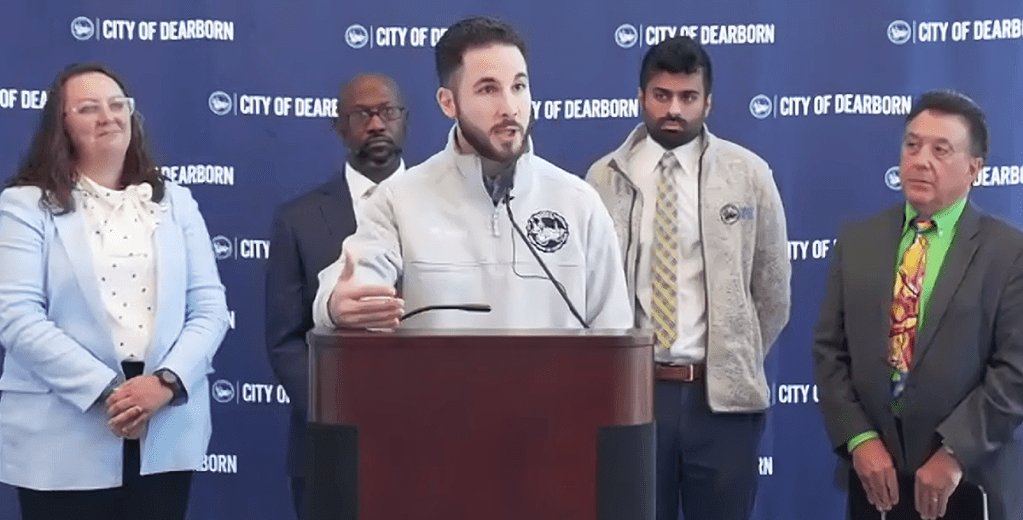
Dearborn Mayor Abdullah H. Hammoud speaks about how the Inflation Reduction Act and the Bipartisan Infrastructure Law federal funding is helping Dearborn with the city’s health-in-all policy mandate to protect everyone in the community at an Elected Officials to Protect America/Climate Action Campaign press conference today. From left to right behind him are the other speakers: Ashely Flintoff, Executive Director – Friends of the Rouge, Christian Brock, CEO of Elected Officials to Protect America, Samir Deshpande MPP, Environmental Health Manager, Dearborn and David Mustonen, on behalf of Glenn Maleyko, Ph.D. Superintendent, Dearborn Public Schools.
Dearborn uses Inflation Reduction Act and Bipartisan Infrastructure Law federal investments to protect residents from climate change
By Ramona du Houx
October 26, 2024
Dearborn, Michigan. Residents of Dearborn know the impacts of the climate crisis. As temperatures have risen the risk of heat stroke has increased, and torrential rains have flooded thousands of homes. Scientists have shown the frequency and intensity of severe storms is increasing. The likelihood of significant flooding like the city experienced in 2014 and 2021, which caused millions of dollars in damage and flooded thousands of homes is always there. Extreme weather also increases energy rates when utilities pass on the costs of rebuilding destroyed electrical infrastructure to consumers.
The good news is — to address this crisis and underlying environmental issues across the city, Dearborn Mayor Abdullah H. Hammoud mandated a health-in-all policies approach, which prioritizes health, environmental justice, and climate action in all public policy decisions.
Please view it HERE.
At a press conference, hosted by Elected Officials to Protect America (EOPA) and the Climate Action Campaign (CAC), Dearborn Mayor Abdullah H. Hammoud joined local leaders to showcase the city’s climate actions. They explained Dearborn’s strategy, which pairs infrastructure investments — funded in part by the Inflation Reduction Act and Bipartisan Infrastructure Law — with changes to municipal ordinances, zoning, and permitting to make the “greenest” choice the easiest choice for businesses and residents.
“As we face the effects of the climate crisis, too many of our residents have faced extreme heat, air and water pollution, and flooding — all of which have disproportionately impacted certain neighborhoods. With our health-in-all policies approach we’ve been able to make significant changes to protect our city from extreme weather, while improving our infrastructure,” said Dearborn Mayor Abdullah H. Hammoud. “I’m proud we are addressing these issues equitably. A safe and healthy environment is a key component of a happy, healthy, and productive city.”
This approach has gained national recognition. Mayor Hammoud was recognized for his leadership with a Mayors Climate Protection Award during the U.S. Conference of Mayors. Dearborn was one of six cities with a population over 100,000 to be recognized.
“We came to Dearborn to celebrate Mayor Abdullah Hammoud’s revolutionary health policy that is bringing equity to his community with his team’s determination to achieve environmental equality on the road to a clean energy economy for all. It was exciting to hear how Dearborn is utilizing the Inflation Reduction Act and Bipartisan Infrastructure Law federal funding with their comprehensive citywide plan of action to combat the ravages of the climate crisis with their equitable health policy,” said Christian Brock, CEO of Elected Officials to Protect America, Air Force Veteran. “Everyone has the right to breathe fresh air, and grow up in an energy secure America.”
Dearborn has partnered with others in Wayne County to apply for and implement several federal programs funded by the Inflation Reduction Act and Bipartisan Infrastructure Law.

Flooding in Dearborn in 2021
“Last year, Dearborn received nearly $24 million to redesign its busy Warren Avenue corridor through the Department of Transportation’s – Safe Streets for All Program to help reimagine traffic and pedestrian safety. In doing so, the city will improve walkability and access to local businesses,” said Samir Deshpande MPP, Environmental Health Manager, Dearborn. “Residents and businesses will benefit from our equitable health policy as they see their quality of life improve.”
Another successful partnership is with the Friends of the Rouge to plant rain gardens in flood-prone areas across the city, an initiative funded by the federal Community Development Block Grant Disaster Relief program. The city received those funds to help recover from catastrophic flooding in 2021.
“We are excited to be part of the solution to alleviate flooding and sewage backups in residential basements that have direct mental and physical health consequences for Dearborn residents, particularly those in the hardest hit neighborhoods like the South End,” said Ashely Flintoff, Executive Director – Friends of the Rouge. “Friends of the Rouge looks forward to deepening our partnership with the community to continue to provide support and resources to the City of Dearborn.”
The South End of Dearborn, which borders southwest Detroit, is the asthma epicenter in the state of Michigan, where asthma rates are two to four times greater.
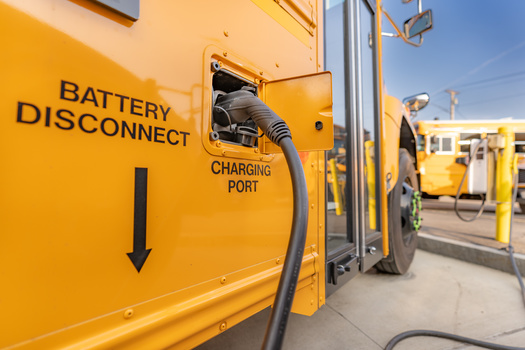
The Dearborn Public School system is working on more electric school buses for their fleet. With funding from the Bipartisan Infrastructure Law, EPA’s new Clean School Bus Program provides $5 billion to replace existing school buses with zero-emission and low-emission models.
“The Dearborn Public Schools has a long history of teaching students to be good stewards of the environment. Funding from the federal government to purchase electric school buses is greatly appreciated and allows us to continue these lessons on reducing emissions, seeking alternative energy sources, and lowering costs, said Glenn Maleyko, Ph.D. Superintendent, Dearborn Public Schools.

David Mustonen, on behalf of Glenn Maleyko, Ph.D. Superintendent, Dearborn Public Schools talks about the greening of Dearborn’s public schools with trees and rain gardens, both help educate students as being good stewards of the planet. He also said 18 new EVs will be added to the fleet, soon. From left to right behind him are the other speakers: Dearborn Mayor Abdullah H. Hammoud, Ashely Flintoff, Executive Director – Friends of the Rouge, Christian Brock, CEO of Elected Officials to Protect America, and Samir Deshpande MPP, Environmental Health Manager, Dearborn.
Dearborn Public Schools is the third largest school district in Michigan with almost 20,000 students. About 45 percent of students are English learners and 80 percent come from homes that are low-income. Dearborn Schools has had six National Blue Ribbon Schools in eight years, including the only high school to make the list in 2021 and a middle school that has been recognized twice (2018 and 2024). The district operates 37 schools across 36 buildings.
Countless parents have worried watching their children waiting for the school bus knowing toxic fumes swirled around their heads. Diesel air pollution is linked to asthma and other health problems that hurt our communities and cause students to miss school, particularly in communities of color. New, zero-emission and low-emission buses will not only reduce greenhouse gas emissions, but produce cleaner air for students, bus drivers, school staff working near the bus loading areas, and the communities that the buses drive through each day.
The Inflation Reduction Act’s incentives and grants are critical to help communities with upfront costs. With solar power, electric vehicle incentives and building retrofitting, homeowners and businesses become more environmentally friendly, and everyone’s quality of life improves.
“Mayor Abdullah Hammoud, his community and team have made Dearborn a model city others should look to for guidance. By putting the health of residents first in all their policy decisions they have shown how to reduce the city’s carbon footprint, create jobs, and improve everyone’s safety and health — equitably,” said Alex Cornell du Houx, former Maine State Representative, Marine combat veteran, President of the Elected Officials to Protect America, and Co-Founder. “The historic funding from the Inflation Reduction Act with the Bipartisan Infrastructure Law have put America on the road to a clean energy economy while cleaning the air, water and land, and growing family-sustaining jobs.”
Prior to his role as mayor, Abdullah Hammoud served as Dearborn’s State Representative in the Michigan House of Representatives, representing the 15th District.
The Inflation Reduction Act provides over $369 billion in tax breaks, incentives, grants, and loan guarantees that will help mitigate the climate crisis which is devastating communities daily with weather extremes and bad air quality.
To assist in community health, amongst other measures the IRA offers:
- Climate Pollution Reduction Grants: A $3 million grant to engage Michigan residents statewide in the strategic implementation of the MI Healthy Climate Plan.
- National Electric Vehicle Infrastructure Program: $110 million Bipartisan Infrastructure Law program to create a statewide, interconnected network of DC fast chargers along the National Highway Systems.
Michigan is already making progress to lower carbon emissions that have caused the climate crisis.
- As of May 2024, utilizing Inflation Reduction Act funding, Michigan has introduced 45 new clean energy projects, ranging from solar and EVs to hydrogen and batteries — the most across any state in the nation.
- According to Climate Power Michigan is No. 1 in the nation for IRA projects, which have resulted in more than $25 billion in new investments across the state
- The state received $159 million in federal funding to help lower the cost of community and rooftop solar installations for thousands of low-income households. The funding comes from the Inflation Reduction Act’s Greenhouse Gas Reduction Fund and is administered through the MI Solar for All program.
- Companies have already announced enough new U.S. battery manufacturing projects to support production of more than 10 million EVs per year.
- The 2023 Clean Jobs America Report stated that clean energy businesses in Michigan added more than 5,400 workers in 2022.
In addition to driving investments in clean energy manufacturing, the Inflation Reduction Act is lowering costs and bringing clean energy and climate solutions to homes and businesses across the state.
Costs for Michigan households and businesses that will be reduced through the IRA:
Michigan received $210.9 million for the Home Energy Rebate Programs. Of this, $105.7 million is allocated for the HEER and $105.2 million is allocated for the HEAR.
- Home Efficiency Rebates Program: A nearly $106 million rebate program for households to make energy efficiency upgrades range from $2,000 to $8,000 per household for low and moderate-income households.
- High-Efficiency Electric Home Rebate Act. A more than $105 million, 10-year rebate program to support low- and moderate-income (LMI) households who choose to invest in electric appliances.