

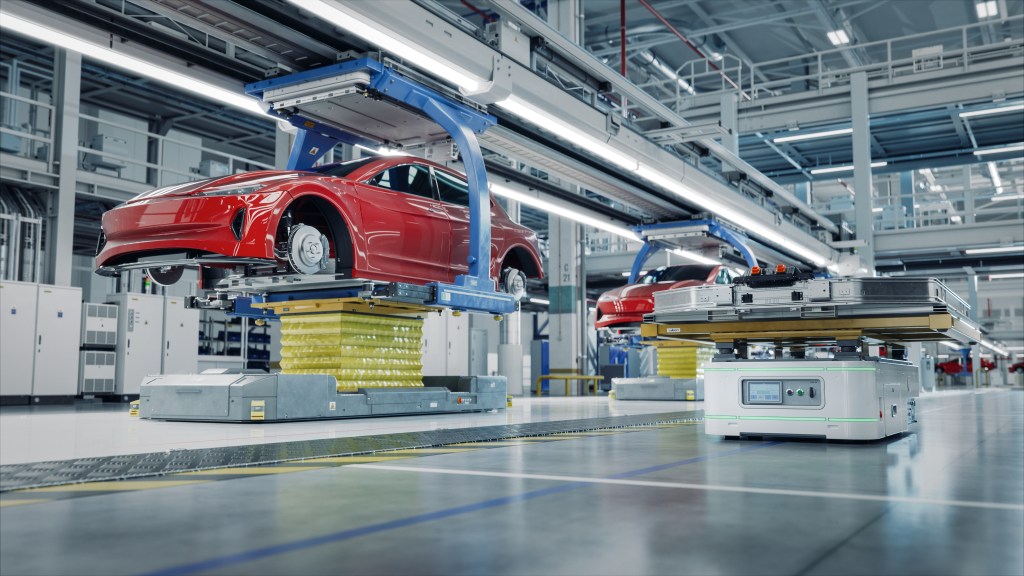
Electric vehicle production has kicked into high gear in 10 states in recent years, including North Carolina. (IM Imagery/Adobe Stock)
Listen to the story HERE
By Eric Teggethoff
Aug 24, 2025
The U.S. is falling behind in the global race to sell electric vehicles according to a new report, and losing that race could harm states with EV manufacturing plants, like Arizona.
The nation still has the chance to catch up with China, its biggest competitor, according to Katherine Yusko – report lead author and research analyst with the American Security Project.
She’s written about the EV race, highlighting some of the ways the U.S. can close the gap with China – as well as some of the biggest barriers.
She said funding from the climate legislation passed under President Joe Biden provides clean manufacturing credits that enable the U.S. to build out a more resilient domestic battery supply.
“Unfortunately, with these credits being phased out by 2033 – this is a new development, as of the ‘Big Beautiful Bill’ – this is likely to slip,” said Yusko. “And there have been billions of dollars in cancellations in battery factories and battery manufacturing since the first months of the Trump administration.”
Yusko noted that tariffs are another challenge, as China has a chokehold on the minerals needed to produce EV batteries.
If the EV market declines in the U.S. it would mean serious impacts for Arizona. The state is home to the eighth largest EV factory in the country, Lucid Motors, which began operating in 2021.
The factory currently has a capacity of 30,000 units, but the company plans to increase capacity to 400,000 units over the next five years.
China accounts for two-thirds of EV sales worldwide, but Yusko had recommendations for how the U.S. can gain ground.
Her first recommendation is to work domestically to increase sales, which would require reversing the decision to end E-V tax incentives next month.
Second, Yusko said the U.S. should adopt a “leap-frogging” strategy in its technology research, since China dominates the EV battery market today.
“It would be more beneficial for it to really prioritize research and development on next-generation batteries, solid-state batteries,” said Yusko, “which are higher-performing than the batteries of today and are very close to commercialization.”
Yusko warned that if the U.S. doesn’t keep up with China on EV sales, it will be handing over a strategic asset to its biggest competitor.
“When I talk about the U.S. ceding the EV race, I don’t just mean the U.S. falls behind in EVs, but it’s okay because it can stay up to pace in these traditionally powered automobiles,” said Yusko. “It won’t be that way. The world is turning toward electric vehicles.”