

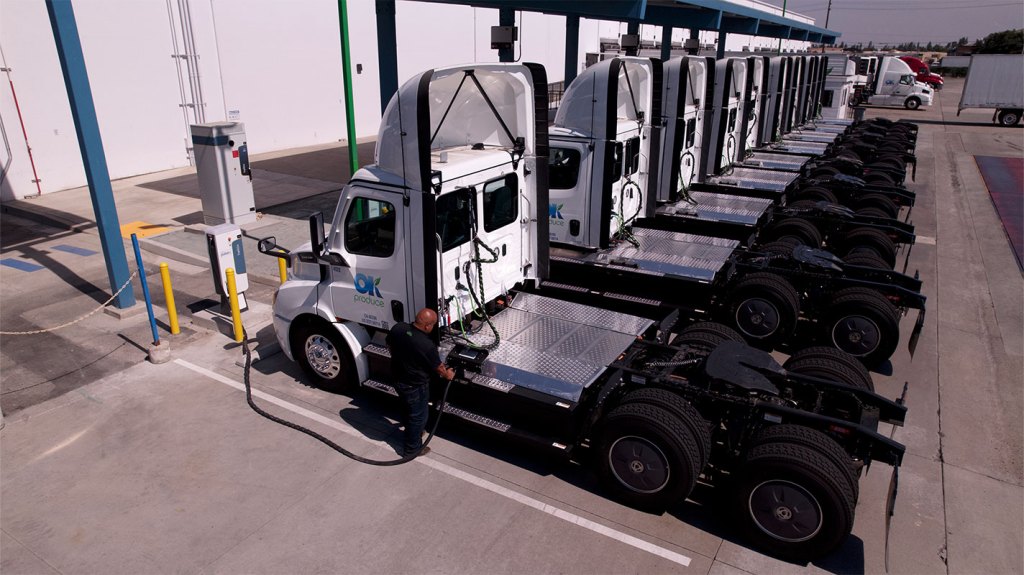
Photo from NACFE’s Run on Less – Electric DEPO
Dec. 11, 2024
The U.S. Environmental Protection Agency (EPA) announced that 70 applicants across 27 states, three Tribal Nations, and one territory have been selected to receive approximately $735 million to assist in the purchase of over 2,000 zero-emission vehicles through its first-ever Clean Heavy-Duty Vehicles Grant Program.
EPA’s Clean Heavy-Duty Vehicles Grant program, created by the Inflation Reduction Act, will replace existing internal combustion engine heavy-duty vehicles with zero-emission vehicles, while also supporting the build out of clean vehicle infrastructure, as well as the training of workers to deploy these new zero-emission technologies. Proposed replacement vehicles include battery-electric box trucks, cargo trucks, emergency vehicles, refuse/recycling haulers, school buses, shuttle buses, step vans, transit buses, utility vehicles, and other vocational vehicles. The program is also expected to fund a small number of hydrogen fuel cell transit buses.
Selected Clean Heavy-Duty Vehicles Grant Program recipients include:
- Boston Public Schools has been selected to receive an anticipated $35,079,653 to replace 125 Class 7 heavy-duty diesel and propane school buses with new, zero-emissions electric units, as well as charging provided by 125 Direct Current Fast Chargers, with advanced load management and sharing capability.
- Saint Louis Public Schools has been selected to receive an anticipated $10,128,735 to replace 30 Class 6/7 diesel buses with Class 6/7 zero-emission buses to reduce the district’s emissions of nitrogen oxides, particulate matter, and greenhouse gases. The project will directly improve the air quality for students, staff, and community members and reduce district transportation costs. In addition, the district plans to leverage a public private partnership with Highland Electric Fleets (Highland) to ensure cost-effective use of EPA funding and successful implementation of the project.
- North Central Texas Council of Governments has been selected to receive an anticipated $60,000,000. NCTCOG will award rebates to program beneficiaries to replace approximately 234 vocational vehicles with 234 zero-emission vehicles. Specific projects will be identified through a Call for Projects to select rebate recipients. Based on a regional fleet survey conducted to inform this proposal, NCTCOG expects the fleet mix to consist mainly of box trucks, step vans, and refuse haulers; most new vehicles will be battery electric with a few hydrogen fuel cell vehicle pilot projects. Each project is expected to include supporting infrastructure. NCTCOG will also develop a regional ZEV workforce development plan, implement priorities identified through the plan and host first responder training specific to ZEV.
- Shakopee Mdewakanton Sioux Community has been selected to receive an anticipated $190,000. SMSC will use grant funding to replace its laundry truck with an all-electric alternative. It has existing charging infrastructure onsite that can be used while it waits for new charging infrastructure to be installed closer to where the vehicle will be parked, enabling the new truck to be in service as quickly as possible.
The selected projects will reduce harmful emissions from heavy-duty vehicles, support good-paying jobs, and improve air quality in communities across the country, particularly in those that have been overburdened by air pollution.
Technical Assistance
The Joint Office offers free and customizable technical assistance to help states, communities, tribal governments, transit agencies, and school districts plan and deploy zero-emission fueling and charging infrastructure, as well as zero-emission vehicles.
13 California applicants will receive $135.2 million total in grants to help purchase 455 zero-emission vehicles through the EPA’s new Clean Heavy-Duty Vehicles Grant Program.
“Heavy-duty vehicle pollution contributes to dangerous air quality across the country, especially here in California,” said EPA Pacific Southwest Regional Administrator Martha Guzman. “By replacing dirty heavy-duty vehicles with clean, zero-emission models, this funding will reduce air pollution, improve health outcomes in nearby communities, and advance the campaign to tackle climate change.”
California Projects:
- Oxnard School District has been tentatively selected to receive an anticipated $4,552,500 to replace 15 fossil fuel-powered school buses with zero-emission models to reduce the district’s emissions of nitrogen oxides, particulate matter, and greenhouse gases. The project will improve air quality for students, staff, and community members, decrease climate pollution, and reduce district transportation costs.
- Oakland Unified School District has been tentatively selected to receive an anticipated $15,178,465 to replace 60 fossil fuel-powered school buses with zero-emission models to reduce the district’s emissions of nitrogen oxides, particulate matter, and greenhouse gases. The project will improve air quality for students, staff, and community members, decrease climate pollution, and reduce district transportation costs.
- The City of Santa Monica has been tentatively selected to receive an anticipated $1,260,000 to replace four fossil fuel-powered street sweepers with fully electric models to reduce emissions of nitrogen oxides, particulate matter, and greenhouse gases. The project will improve air quality for those who live and breathe nearby and reduce climate pollution.
- Los Angeles Unified School District’s Transportation Services Division has been tentatively selected to receive an anticipated $20,374,355 to replace 50 fossil fuel-powered school buses with zero-emission electric models and install supporting electric charging infrastructure. This project will significantly reduce emissions that contribute to poor air quality and support workforce development activities to train and recruit local community members for zero-emission technology-related jobs.
- Golden Empire Transit has been tentatively selected to receive an anticipated $6,734,220 to replace five fossil fuel-powered buses with zero-emission electric models to reduce the district’s emissions of nitrogen oxides, particulate matter, and greenhouse gases. The project will improve air quality for students, staff, and community members, decrease climate pollution, and reduce district transportation costs.
- The City of Oakland has been tentatively selected to receive an anticipated $1,456,008 to replace four diesel-fueled vehicles—one refuse hauler and three short-haul street sweepers— with zero-emission electric models. The project will reduce emissions of nitrogen oxides, particulate matter, and greenhouse gases, improving air quality for those who live and breathe nearby.
- The City of Oakland’s Port Department has been tentatively selected to receive an anticipated $10,499,274 to replace 60 UPS delivery trucks with zero-emission battery electric models and install supporting charging infrastructure at three different logistics centers in Oakland, San Francisco, and Richmond. The project will benefit some of the region’s most vulnerable and underserved communities in the three cities.
- The City of Pico Rivera has been tentatively selected to receive an anticipated $762,750 to replace three diesel vehicles—a bucket truck, a vacuum truck, and a dump truck— with zero-emission models to reduce the emissions of nitrogen oxides, particulate matter, and greenhouse gases. The project will directly improve air quality for community members, decrease climate pollution, and reduce city transportation costs.
- San Joaquin Valley Unified Air Pollution Control District has been tentatively selected to receive an anticipated $8,933,333 to replace 26 fossil fuel-powered Class 6 and 7 on-road trucks operating within the Valley with new zero-emission models. The project will reduce emissions of nitrogen oxides, particulate matter, and greenhouse gases, directly improving the air quality for community members and reducing climate pollution.
- South Coast Air Quality Management District has been tentatively selected to receive an anticipated $24,842,632 for a project offering incentive funding to replace up to seventy-four fossil fuel-powered school buses with zero-emission electric models and install seventy-four new chargers to support the new electric buses. The project will improve air quality for students, staff, and community members, decrease climate pollution, and reduce district transportation costs.
- The California Department of Transportation has been tentatively selected to receive an anticipated $2,090,000 to replace eleven diesel- and gasoline-powered cargo trucks with battery-electric models. The project will reduce emissions of nitrogen oxides, particulate matter, and greenhouse gases, improving air quality and reducing climate pollution.
- The City of Pasadena has been tentatively selected to receive an anticipated $4,615,000. This project will replace seventeen Class 6 and Class 7 fossil fuel vehicles with zero-emission electric models and install seventeen electric charging units to accommodate the new electric vehicles. The project will reduce emissions of nitrogen oxides, particulate matter, and greenhouse gases, improving air quality and reducing climate pollution.
- South Coast Air Quality Management District has also been selected to receive an anticipated $33,898,522. The project will replace 126 high-mileage heavy-duty vehicles equipped with internal combustion engines, including box trucks, transportation refrigeration unit trucks, and step vans, with battery-electric models. The project will deploy 94 electric chargers to support the new electric vehicles. Additional charging infrastructure will be provided by existing chargers at the fleets and public truck charging stations funded by various South Coast AQMD incentive programs and the recently awarded EPA Climate Pollution Reduction Grant to South Coast AQMD. The project will significantly reduce emissions of nitrogen oxide, particulate matter, and greenhouse gasses, improving air quality for those who live and breathe nearby and reducing climate pollution. Additionally, the project will implement a comprehensive engagement program that complements existing efforts to uplift community priorities and provide equitable benefits from the transition to zero-emission technologies, as well as prioritize workforce training to ensure the successful deployment of battery electric technologies while providing job opportunities.