


The article first appeared in AJOT Insights
by Stas Margaronis Jan 16, 2024
Offshore wind farms can be a major source of U.S. renewable wind energy but a major public/private investment in U.S. ports similar to the post WWII Marshall Plan is needed, according to Dr. Habib Dagher, the founding Executive Director of the University of Maine’s Advanced Structures and Composites Center.
Read part two below or here: Dagher Says Offshore Wind Supply Chain Problems Are Manageable
“I have advocated for a Marshall Plan for U.S. ports”
Dr. Habib Dagher, Executive Director of the University of Maine’s Advanced Structures and Composites Center.
Dr. Dagher has been a pioneering force for floating offshore wind development in the United States. Under his direction, the University of Maine launched the first floating wind turbine: a prototype that was tested in the Gulf of Maine in 2013.
Wanted: A Marshall Plan for U.S. Ports

In an interview with AJOT, Dagher said that the Port of Long Beach’s proposed floating wind turbine port, ‘Pier Wind’, could be a role model and a game-changer for the United States with the capacity to mass produce and deploy a fleet of offshore wind turbines for the U.S. Pacific Coast.
The Port of Long Beach projects that it will begin construction on its 400 acre ‘Pier Wind’ offshore wind port in 2027 that is projected to cost $4.7 billion, according to Suzanne Plezia, Senior Director/Chief Harbor Engineer for the Port of Long Beach.
‘Pier Wind’ reflects the vision of Port of Long Beach Executive Director Mario Cordero who has advocated for renewable and zero emission port operations at Long Beach and sees the ‘Pier Wind” offshore wind facility as a new economic development generator for ports.
This vision complements Dr. Dagher’s vision: “I have advocated for a Marshall Plan for U.S. ports” adding ‘I have had discussions with officials associated with the Port of Long Beach’s Pier Wind project. That project could be a game changer for floating offshore wind because of the scale of the proposed offshore wind port that Long Beach proposes. When you look at floating offshore wind … you have to construct the hulls. The hulls are very big structures that could be 300 feet in diameter, so … you need large areas where these can be constructed out of steel or concrete. This means huge … fabrication and assembly facilities for the hulls. And you’ve got the rest of the components such as the towers and the turbines …’”
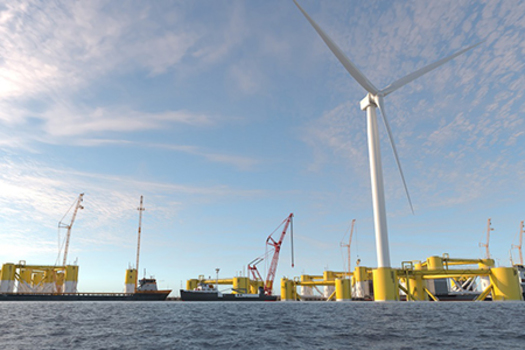
The result, he said, is that offshore wind ports will: “need a lot of large lay down space … to produce these components … that can encompass anywhere from 200 acres up to 600 or more acres … These are large facilities that require deep water access. You need to have … 35 or 40 feet of water at the port … at the dock side to be able to place these units on the water and they need to have a clear shot to the ocean. You can’t have bridges in the way. … So, there are very few locations where you can do all that … on the West Coast and on the East Coast. And they’re not inexpensive. So, for these ports, the investments are large and you’re looking at investments anywhere from $400 million for a small port to upwards of a billion for a larger port.”
Port of Long Beach’s ‘Pier Wind’
Last September, the Port of Long Beach’s Suzanne Plezia told AJOT: “We are doing everything to meet the aggressive timeline that we put in our concept report with the start of construction in January of 2027. So, it’s a very challenging … aggressive timeline but that gets our permits in place by mid-2026 … We did a cost and schedule in our concept report. The … cost is estimated at $4.7 billion in 2023 dollars.”
Plezia said that the number of floating wind turbines that will be built to meet the initial goals for offshore wind farms in Northern and Central California will depend on the power generating capacity of the wind turbines which she said would range from 15 MW (megawatts) to 20 MW per turbine. This would call for the construction of 400-500 floating wind turbines:
“I think they’re going to be trying for 20 megawatt turbines. I think that’s what they’re hoping for … based on the press releases from each of the developers … when I added them up, they added up to 8 gigawatts. So, if it’s 8 gigawatts (i.e., 8,000 megawatts) then that’s five hundred and thirty-three 15-megawatt wind turbines or if the wind turbines generate 20 megawatts … it’s 400, right? So somewhere between 400 and 533 wind turbines.”
The floating platform for each wind turbine would barely fit inside a baseball stadium such as Dodger Stadium in Los Angeles, Plezia said.
Dagher concurred: “You are looking at very significant investments to establish these port facilities. So … those are needed if you’re going (to) be able to reach our goals of 15 gigawatts by 2035 for floating wind. We need floating wind ports, and we don’t have them. So, the question is who will build and finance them? The developers who will use these ports will be paying fees to use them. So that’s part of the financing structure. … Also, the states who want the jobs in their state will also need to invest in the ports and then the federal government will need to participate in the investment if we are to achieve the national goals of 45 gigawatts. We could see these as a public-private initiative to put these ports together supported by both the state and federal governments as well as industry projects.”
Maine’s Offshore Wind Plans
Dagher says the University of Maine plans to place a floating wind turbine in operation next year: “We have a project … next year. It’s a demonstration project … funded through ARPA (American Rescue Plan Act). It’s a new design that’s lighter and smaller yet does the same thing that we’ve been working on. So, we’re very excited about that …. It will have a capacity to generate 225 kilowatts.”
Last July, the Associated Press reported that Maine will procure at least 3,000 megawatts of electricity from offshore wind turbines by 2040 under a bill signed by Democratic Governor Janet Mills, enough to power about half of the state’s electricity load.
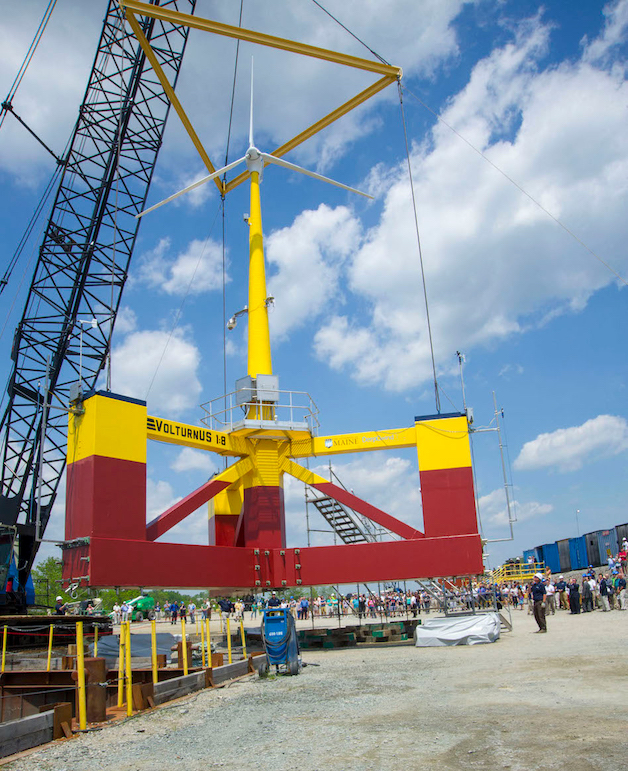
PHOTO: The VolturnUS floating offshore wind platform launch in Brewer Maine. The design by Dr. Habib Dagher and his team at the University of Maine is a prototype that weathered storms in the Atlantic with ease. It’s 1:8 the size of turbines that will be deployed off the coast of Maine.
Unlike other projects in the region, the Gulf of Maine wind turbines would showcase floating platform technology because of the depth of the ocean floor.
State officials hope companies will utilize technology from the University of Maine, which has been pioneering precast floating turbines and has tested prototypes off the coast. (See Gary Burrows “Offshore floating wind energy solution for US energy gap” Dec. 18, 2023, issue 760, page 14). Dagher told AJOT that the Maine wind turbines will be powered by: “10-15 megawatt units that would be deployed near the end of the decade.”
Part two:
Major supply chain dislocations have hampered offshore wind development in recent years but Dr. Habib Dagher, the founding Executive Director of the University of Maine’s Advanced Structures and Composites Center, and an offshore wind pioneer believes they will be solved.
In an exclusive interview with AJOT, Dagher said that supply chain issues “…have surfaced … throughout the construction industry, not just through offshore wind … since the pandemic … What we hope is … the industry is recalibrating right now to try to figure out … how to meet some of the goals. The U.S. has a goal of 30 gigawatts by 2030 of fixed bottom wind turbines. In addition, another 15 gigawatts of floating wind are projected by 2035. So … there’s a 45 gigawatt projection between now and 2035 in the U.S. … Certainly there are risks of delays now because of the supply chain issues (but) eventually the wind farms will be built, it’s just a matter of time. I don’t think it is going (to) be exactly by 2035 or 2030 … that’s the question that remains.”
Dr. Habib Dagher, the founding Executive Director of the University of Maine’s Advanced Structures and Composites Center
Technological Innovations Could Simplify Supply Chain
Dagher said one example of new technology that could simplify the production and supply chain process is the introduction of synthetic anchor handling lines replacing anchor chains made of steel to anchor floating wind turbines in several thousand feet of water:
“There are two types of anchor chains for anchoring the floating wind turbine. There are the steel chains and synthetic mooring lines. The synthetic mooring lines … are a lot lighter than the steel chain and a lot easier to handle. Capacity is being ramped up right now globally to produce these synthetic mooring lines. There is not enough capacity globally right now to just … manufacture steel chains … if we’re going to meet our goals within the timelines and deployment timelines. So, the industry has stepped up and in Europe, companies are building facilities to produce synthetic mooring lines. I would say these floating deep-water units will be using synthetic systems, not steel chains.”
Dagher proposes offshore wind turbines be built on concrete foundations or hulls. The advantage of the concrete hull is that the design will allow for construction at U.S. shipyards by U.S. workers and not require sourcing the foundations from an offshore shipbuilder. The hull can be launched from a fabrication yard in 25 feet of water, which makes the process adaptable for construction in many shallow draft locations.
The University of Maine’s so-called VolturnUS hull design utilizes a concrete semi-submersible floating hull and a composite material tower. Once the hull is launched, the tower and turbines can be added, and the complete installation floated out to sea for anchorage and wind power generation. Dagher says this process could avoid building steel hulls which would be a simpler process:
“Using concrete for the hulls of the wind turbines, we do not have to weld, right? So, we pour concrete into molds and then we can build the hulls locally instead of sourcing the steel work to a foreign shipyard … Concrete can be produced locally more easily than steel hulls …and that technology already exists.”
Operational Advantages of Floating Wind Turbines
Dagher noted that there are challenges for fixed bottom wind turbines being built on the U.S. East Coast: “You need jack up vessels that are able to carry the turbine and tower and place it on a fixed foundation. Those vessels are big and expensive … and some of them are getting built in the United States at U.S. shipyards but not fast enough.”
The problem is less severe for the floating wind turbines: “The good news is we don’t need the same vessels. We don’t need complex vessels like that. We need anchor handling vessels. We also need vessels to tow the floating hulls to the wind farm site. … You will also need cable-laying vessels to install transmission cable under the seabed, linking the wind farms to shore. You will also need other types of safety vessels … smaller vessels to do that … Many of those vessels exist in the U.S. already.”
In another innovation the University of Maine’s VolturnUS’s hull includes a tuned mass damper, also known as a seismic damper, a device mounted in structures to reduce mechanical vibrations.
Dagher said the technology allows “us to reduce the size of the hull. The hull does not move as much in the water … And when the extreme waves come in … we’re able to dampen the … motion significantly. We are able to build a smaller hull plus the hull design has been simplified. It’s easier to build and our goal is still to build it locally, so to create local jobs in the U.S.… and that allows us to reduce the whole weight mass.”

Dagher also notes the need for dynamic cables: “We will need what is called dynamic cable which transfer(s) electricity from the wind turbine that moves with the hull and links up with the transmission cable, which is a static cable on the seabed floor. Producing these dynamic and static cables is a real opportunity for manufacturing in the United States.”
The U.K. based firm TechnipFMC says it has supplied dynamic systems to the oil and gas industry for 30 years and dynamic power cables for 25 years according to its website. The company says the problem that might be relatively easy to solve on a bottom-fixed wind farm becomes a different and more complex one on a floating offshore wind turbine: “There will be multiple cables connecting multiple floating wind turbines together, transferring power from each wind turbine to the other floating wind turbines and eventually to a fixed, non-floating substation.”
Therefore, it is vital: “ensuring that the Dynamic Inter Array Cable is manufactured without any inherent defects.” That means ensuring: “the building blocks of the Dynamic Inter Array Cable System are being optimized, there is already control of schedule and reliability and cost risks are managed. There won’t be cost inflation due to poor scheduling, downtime, service or installation failures or manufacturing defects.”
The company says subsea cables, responsible for roughly 80% of wind insurance claims, “are seen to be the element with the highest risk for failure. The move to floating offshore wind is expected to increase the losses and associated costs. Management of the inherent risk of subsea cables is arguably the greatest benefit using a Dynamic Inter Array Cable System has to offer.”
Inflation and Financing
Dagher believes inflation caused short term disruptions to offshore wind development but a new recognition of factoring inflation into Power Purchase Agreements is recognized and will restart developments:
“The big issue we faced is that while projects were secured with Power Purchase Agreements (PPAs) they were obtained prior to the pandemic and did not include an inflation adjustment as part of the purchase agreement. So, when the inflation went up so high … you got more than 40% inflation since the pandemic, sometimes in some cases up to a 100% inflation, depending on the products. What happened is the Power Purchase Agreement that existed prior to the pandemic … was no longer sufficient to cover the costs. Unfortunately, there was … no … foresight in these agreement(s) that said, ‘we’ll agree to pay for inflation.’ The public partners who were buying the energy, which were essentially in-state entities or public utilities commissions and others, did not include an inflation adjustment in some of these contracts. The good news is the new contracts are being worked on right now. People understand that … and they’re starting to include inflation … (Also) inflation is starting to stabilize. So … what we learned from all this is that … we (are) … very sensitive to inflation because we’re a capital-intensive industry, … and therefore inflation really needs to be front and center in Power Purchase Agreements…”
Dagher notes: “The big developers … have brought some of their own equity into these projects and (can) self-finance the development as well as potentially part of the construction of the project … A variety of interested parties including investors, investment banks … actually do these kinds of projects. And they do them in Europe … specialized companies that specialize in offshore wind, and some are specializing also in floating offshore wind financing. So those dollars will arrive.”