

$7 Billion For America’s First Clean Hydrogen Hubs, Driving Clean Manufacturing and Delivering New Economic Opportunities Nationwide
February 10, 2024
The Regional Clean Hydrogen Hubs (H2Hubs) will kickstart a national network of clean hydrogen producers, consumers, and connective infrastructure while supporting the production, storage, delivery, and end-use of clean hydrogen. Funded by the Bipartisan Infrastructure Law (BIL), the H2Hubs will accelerate the commercial-scale deployment of clean hydrogen helping to generate clean, dispatchable power, create a new form of energy storage, and decarbonize heavy industry and transportation. Together, they will also reduce 25 million metric tons of carbon dioxide emissions from end-uses each year—an amount roughly equivalent to combined annual emissions of 5.5 million gasoline-powered cars—and create tens of thousands of good-paying jobs across the country while supporting healthier communities.
Key areas DOE evaluated when selecting H2Hubs included:
- Technical Merit and Impact, including but not limited to the ability of the proposed hub to deploy infrastructure and produce at least 50-100 metric tons of clean hydrogen per day and reduce greenhouse gas emissions.
- Financial and Market Viability, including growth potential and market competitiveness of the proposed hub.
- Workplan, including the speed at which the hub could begin operations and overall project management details.
- Management Team and Project Partners, including the team’s ability to execute the plan with a high level of success.
- Community Benefits Plan, including an assessment of community and labor engagement, quality job creation and workforce development, diversity equity inclusion and accessibility, and the Justice40 Initiative.
“Unlocking the full potential of hydrogen—a versatile fuel that can be made from almost any energy resource in virtually every part of the country—is crucial to achieving President Biden’s goal of American industry powered by American clean energy, ensuring less volatility and more affordable energy options for American families and businesses,” said U.S. Secretary of Energy Jennifer M. Granholm. “With this historic investment, the Biden-Harris Administration is laying the foundation for a new, American-led industry that will propel the global clean energy transition while creating high quality jobs and delivering healthier communities in every pocket of the nation.”
Clean hydrogen is a flexible energy carrier that can be produced from a diverse mix of domestic clean energy resources, including renewables, nuclear, and fossil resources with safe and responsible carbon capture. Its unique characteristics will allow the H2Hubs to substantially reduce harmful emissions from some of the most energy-intensive sectors of the economy, such as chemical and industrial processes and heavy-duty transportation. It could also be used as a form of long-duration energy storage to support the expansion of renewable power.
Project Name: Appalachian Hydrogen Hub
Selectee name: Appalachian Regional Clean Hydrogen Hub (ARCH2)
Location: West Virginia, Ohio, and Pennsylvania
Federal Cost Share: up to $925 million
Prime Contractor: Battelle
Summary: The Appalachian Hydrogen Hub will span across West Virginia, Ohio, and Pennsylvania and leverage the region’s ample access to low-cost natural gas to produce low-cost clean hydrogen and permanently store the associated carbon emissions. The strategic location of the Appalachian Hydrogen Hub and development of hydrogen pipelines, multiple hydrogen fueling stations, and permanent CO2 storage also have the potential to drive down the cost of hydrogen distribution and storage. The Appalachian Hydrogen Hub will help the nation lead in the advancement of the hydrogen economy while reducing emissions and pollution that has long affected air quality in overburdened communities of Appalachia. This Hub will focus on replicable projects to create a pathway for reducing long-term technology costs that can scale greater benefits for the region and beyond. The Hub intends to reduce CO2 emissions by 9 million metric tons per year—equivalent to the annual emissions of more than 2 million gasoline-powered cars.
The Appalachian Hydrogen Hub is anticipated to bring quality job opportunities to workers in coal communities and create more than 21,000 direct jobs – including more than 18,000 in construction and more than 3,000 permanent jobs, helping ensure the Appalachian community benefits from the development and operation of the Hub. To create equitable workforce development opportunities, several H2Hub partners have committed to continuing current or pursuing new workforce and community agreements, in addition to developing new partnerships with colleges and workforce organizations. The Appalachian Hydrogen Hub plans to create a Community Benefits Advisory Board to oversee implementation of the Community Benefits Plan (CBP) and a Community Commitment Fund to ensure the Hub reenergizes the Appalachian region economically, socially, and environmentally.
For more information, email AppalachianH2Hub@hq.doe.gov.
Project Name: California Hydrogen Hub
Selectee name: Alliance for Renewable Clean Hydrogen Energy Systems (ARCHES)
Location: California
Federal Cost Share: up to $1.2 billion
Prime Contractor: Alliance for Renewable Clean Hydrogen Energy Systems (ARCHES) LLC
Summary: The California Hydrogen Hub spans across the state of California and will leverage the state’s leadership in clean energy technology to produce hydrogen exclusively from renewable energy and biomass. The California Hydrogen Hub will provide a blueprint for decarbonizing public transportation, heavy duty trucking, and port operations—key emissions drivers in the state and sources of air pollution that are among the hardest to decarbonize. In particular, the California Hydrogen Hub will introduce clean hydrogen to heavy duty transport through cargo handling equipment and drayage to support the eventual conversion of maritime equipment at ports and prepare the port for the potential export of hydrogen. The California Hydrogen Hub aims to reduce carbon emissions by 2 million metric tons per year—roughly equivalent to the annual emissions of 445,000 gasoline-powered cars. The expansion of hydrogen fuel cell vehicles in heavy duty transportation will not only drive improvements in air quality along high pollution interstate transportation corridors but will facilitate greater connectivity and expansion of a clean West Coast freight network that links to the Pacific Northwest Hydrogen Hub. The California Hydrogen Hub will launch the use of hydrogen for power generation, advancing energy security and more resilient systems through a partnership with the Rincon Band of Luiseño Indians. This partnership will use hydrogen to provide backup power to community well water pumps to ensure clean drinking water during power outages. The impact of the California Hydrogen Hub is amplified by the state of California’s strong policy and regulatory support for hydrogen including permitting, and, potentially, production and use incentives.
To ensure the California region’s communities are engaged and have access to the benefits of a clean hydrogen economy, this Hydrogen Hub plans to incorporate robust governance mechanisms, including labor, tribal, and environmental representation on its governing board; strong state requirements for environmental justice; independent monitoring of CBP implementation; and a CBP scorecard with monetary penalties for noncompliance. This H2Hub includes the California State Building & Construction Trades Council as a founding member and has committed to requiring Project Labor Agreements for all projects connected to the Hub. The H2Hub will also partner with local and minority-owned businesses, minority-serving institutions, and organizations targeting workers facing employment barriers to ensure economic benefits and quality jobs are available to underrepresented groups. This H2Hub anticipates creating 220,000 direct jobs—130,000 in construction jobs and 90,000 permanent jobs. In addition to economic benefits, this H2Hub will also provide local benefits to communities including reducing harmful air pollution that will result in significant health-related savings each year at full buildout.
For more information, email CaliforniaH2Hub@hq.doe.gov.
Project Name: Gulf Coast Hydrogen Hub
Selectee name: HyVelocity H2Hub
Location: Texas
Federal Cost Share: up to $1.2 billion
Prime Contractor: HyVelocity, Inc.
Summary: The Gulf Coast Hydrogen Hub will be centered in the Houston region, the traditional energy capital of the United States, and will stretch across the Texas coast. The Gulf Coast Hydrogen Hub will help kickstart the clean hydrogen economy with its plans for large-scale hydrogen production using both natural gas with carbon capture and renewables-powered electrolysis, leveraging the Gulf Coast region’s abundant renewable energy and natural gas supply to drive down the cost of hydrogen—a crucial piece to achieving market liftoff. To help lower the cost of distribution and storage and reach more hydrogen users, the Gulf Coast Hydrogen Hub plans to develop salt cavern hydrogen storage, a large open access hydrogen pipeline, and multiple hydrogen refueling stations. The Gulf Coast Hydrogen Hub will use the hydrogen for fuel cell electric trucks, industrial processes, ammonia, refineries and petrochemicals, and marine fuel (e-Methanol). The introduction of clean hydrogen into these industries is estimated to reduce CO2 emissions by 7 million metric tons per year, equivalent to the annual emissions of more than 1.5 million cars.
The Gulf Coast Hydrogen Hub will create a Community Advisory Board, which includes two councils that will leverage the capabilities of education and community partners, including minority-serving institutions, to support inclusive and equitable workforce development and community investment. The Gulf Coast Hydrogen Hub anticipates creating approximately 45,000 direct jobs—35,000 in construction jobs and 10,000 permanent jobs. A key Justice40 benefit for this Hub is reduction in air pollution, including particulate matter.
For more information, email GulfCoastH2Hub@hq.doe.gov.
Project Name: Heartland Hydrogen Hub
Selectee name: Heartland Hub (HH2H)
Location: Minnesota, North Dakota, and South Dakota
Federal Cost Share: up to $925 million
Prime Contractor: Energy & Environmental Research Center (EERC)
Summary: The Heartland Hydrogen Hub consists of project locations across North Dakota, South Dakota, and Minnesota, with the potential to expand into neighboring states, that will leverage the region’s abundant energy resources to help decarbonize the agricultural sector’s production of fertilizer and decrease the regional cost of clean hydrogen. The Heartland Hydrogen Hub also proposes to use clean hydrogen for power generation in a manner that may catalyze co-firing hydrogen in utility-owned generation across the country. The Hub plans to offer unique opportunities of equity ownership with the Mandan, Hidatsa and Arikara Nation and to local farmers and farmer co-ops through a private sector partnership that will allow local farmers to receive more competitive pricing for clean fertilizer. These initiatives can help reduce roughly 1 million metric tons per year of carbon emissions—roughly equivalent to the annual emissions of 220,000 gasoline-powered cars—while extending profit-sharing and benefits from the expanding hydrogen economy to wider communities, a model with the potential for replication across the Midwest. The Heartland Hydrogen Hub’s use of open access storage and pipeline infrastructure will create a hydrogen network accessible to both current and new hydrogen users.
The Heartland Hydrogen Hub has committed tens of millions of dollars to create an education consortium to oversee career development, workforce training, apprenticeship programs, and K-12 STEM education, which includes several tribal colleges and universities. A goal of the Heartland Hydrogen Hub is to contract hundreds of millions of dollars for businesses owned by women, minorities, disabled veterans, disadvantaged communities, or LGBTQ persons. The Heartland Hydrogen Hub anticipates creating upwards of 3,880 direct jobs–3,067 in construction jobs and 703 permanent jobs. To oversee implementation of the Community Benefits Plan (CBP), this H2Hub intends to create a CBP Advisory Board.
For more information, email HeartlandH2Hub@hq.doe.gov.
Project Name: Mid-Atlantic Hydrogen Hub
Selectee name: Mid-Atlantic Clean Hydrogen Hub (MACH2)
Location: Pennsylvania, Delaware, and New Jersey
Federal Cost Share: up to $750 million
Prime Contractor: Mid-Atlantic Clean Hydrogen Hub, Inc.
Summary: The Mid-Atlantic Hydrogen Hub spans the Delaware River and includes Pennsylvania, Delaware, and southern New Jersey. The Mid-Atlantic Hydrogen Hub will help unlock hydrogen-driven decarbonization in the Mid-Atlantic while repurposing historic oil infrastructure and using existing rights-of-way. The Mid-Atlantic Hydrogen Hub plans to develop renewable hydrogen production facilities from renewables and nuclear electricity using both established and innovative electrolyzer technologies, where it can help reduce costs and drive further technology adoption. It aims to expand hydrogen application to industries including heavy transportation (e.g., trucks, buses, refuse trucks, and street sweepers), manufacturing and industrial process improvements, and combined heat and power, where it can significantly reduce carbon emission by approximately 1 million metric tons per year, which is roughly equivalent to the emissions from 220,000 cars annually. Along with hydrogen production, the Mid-Atlantic Hydrogen Hub plans to expand hydrogen distribution infrastructure, upgrade bus mechanic depots, and develop fueling stations to facilitate hydrogen distribution to more end users. The expansion of hydrogen infrastructure will lower the costs of storage and distribution and ultimately assist with reducing the cost of hydrogen and achieving anticipated emissions reductions.
As part of its labor and workforce commitments to the community, the Mid-Atlantic Hydrogen Hub plans to negotiate Project Labor Agreements for all projects and provide close to $14 million for regional Workforce Development Boards that will serve as partners for community college training and pre-apprenticeships. The Mid-Atlantic Hydrogen Hub was developed in partnership with labor and minority-serving institutions, including the Philadelphia Building Trades and Cheyney University and intends to support apprenticeship and pre-apprenticeship programs, certificated and stackable credentials, and wraparound services that enable training and employment. The Mid-Atlantic Hydrogen Hub anticipates creating 20,800 direct jobs—14,400 in construction jobs and 6,400 permanent jobs. Hub partners have agreed to union neutrality and will abide by good faith negotiations. To overcome barriers for underrepresented groups, this Hub plans to provide an additional $10 million for technical and professional development initiatives, such as an on-site, hands-on hydrogen training program at Cheyney University, the oldest HBCU in the country. Additional benefits include air pollutant reduction and brownfield remediation. To ensure accountability, the Mid-Atlantic Hydrogen Hub plans to create a Community Advisory Board and establish third party verification.
For more information, email MidAtlanticH2Hub@hq.doe.gov.
Project Name: Midwest Hydrogen Hub
Selectee name: Midwest Alliance for Clean Hydrogen (MachH2)
Location: Illinois, Indiana, and Michigan
Federal Cost Share: up to $1 billion
Prime Contractor: MachH2
Summary: The Midwest Hydrogen Hub network spans Illinois, Indiana, and Michigan, with the potential to expand into other Midwestern states. Located in a key U.S. industrial and transportation corridor, the Midwest Hydrogen Hub will enable decarbonization through strategic hydrogen uses including steel and glass production, power generation, refining, heavy-duty transportation, and sustainable aviation fuel. The decarbonization of these sectors will reduce carbon emissions by approximately 3.9 million metric tons per year—equivalent to removing emissions from more than 867,000 gasoline powered cars annually—improving air quality through avoided criteria pollutant emissions. The Midwest Hydrogen Hub plans to produce hydrogen by leveraging diverse and abundant energy sources, including renewable energy, natural gas, and low-cost nuclear energy.
The Midwest Hydrogen Hub will ensure diverse hiring and contracting and create an equitable enterprise development program that expands the benefit and reach of the local hydrogen economy. For example, the Midwest Hydrogen Hub has created specific targets to ensure diverse hiring and contracting, including 40 percent of total subcontracted dollars going to Minority/Disadvantaged Business Enterprises (M/DBEs), roughly $30 million for new startups through an inclusive entrepreneurship program (focusing on M/DBEs), and a target of 45 percent diverse hiring. The H2Hub plans to create a worker education exchange, invest roughly $15 million in wraparound services that enable training and employment, and support project partners to negotiate workforce and community agreements. The Midwest Hydrogen Hub anticipates creating 13,600 direct jobs—12,100 in construction jobs and 1,500 permanent jobs and plans to create a Community Benefits Advisory Working Group in addition to localized advisory councils.
For more information, email MidwestH2Hub@hq.doe.gov.
Project Name: Pacific Northwest Hydrogen Hub
Selectee name: PNWH2 Hub
Location: Washington, Oregon, and Montana
Federal Cost Share: up to $1 billion
Prime Contractor: Pacific Northwest Hydrogen Association
Summary: The Pacific Northwest Hydrogen Hub will span Washington, Oregon, and Montana, and plans to leverage the region’s abundant renewable resources to produce clean hydrogen exclusively via electrolysis. The Pacific Northwest Hydrogen Hub’s vast use of electrolyzers will play a key role in driving down electrolyzer costs, making the technology more accessible to other producers, and reducing the cost of hydrogen production. The Pacific Northwest Hydrogen Hub aims to remove approximately 1.7 million metric tons per year of CO2 emissions—equivalent to removing the emissions from roughly 346,000 gasoline-powered cars annually—through a transition to clean hydrogen across hard-to-decarbonize areas. These hard-to decarbonize areas include heavy duty transportation, where clean hydrogen will help address a key mobile source of nitrous oxide emissions. The Hub’s plan for hydrogen fuel cell vehicle expansion in heavy duty trucking will be carried out in conjunction with the California Hydrogen Hub’s parallel efforts. This will help enable development of a West Coast freight network that addresses refueling gaps and further clean transportation expansion. Other hydrogen uses include agriculture (fertilizer production), industry (generators, peak power, data centers, refineries), and seaports (drayage, cargo handling), where it will serve to decarbonize some of the highest emission drivers in the region.
Founded with unions, environmental groups, and tribal representatives, the Pacific Northwest Hydrogen Hub includes representation from these groups on its planned Community Benefits Plan governing board. The Pacific Northwest Hydrogen Hub has committed to negotiating Project Labor Agreements for all projects over $1 million and investing in joint labor-management/state-registered apprenticeship programs. Workforce commitments include priority hiring programs for former coal industry workers and investing more than $4 million in the Centralia College training center to provide worker training. This Hub notes that attracting, training, and retaining local skilled, qualified, local, and diverse construction and operations workforces begins with leveraging high union density through collaboration with local labor unions and relevant workforce bodies. This H2Hub anticipates creating more than 10,000 direct jobs—8,050 in construction jobs and 350 permanent jobs.
For more information, email PacificNWH2Hub@hq.doe.gov.
What is Clean Hydrogen?
Clean hydrogen refers to hydrogen produced through electrolysis—separating liquid water into hydrogen—using renewable or low-carbon emissions energy sources, such as wind, solar or nuclear. Clean hydrogen can also refer to hydrogen produced using thermal conversion processes with carbon capture and permanent storage (CCS) technologies that reduce greenhouse gas emissions.
As such, clean hydrogen technologies can enable reduced emissions compared to traditional fossil fuels, either by virtue of the production method or through CCS.
Learn more about clean hydrogen in this video: https://www.youtube.com/watch?v=hi6rx5Ck8Ms
What is a Hydrogen Hub?
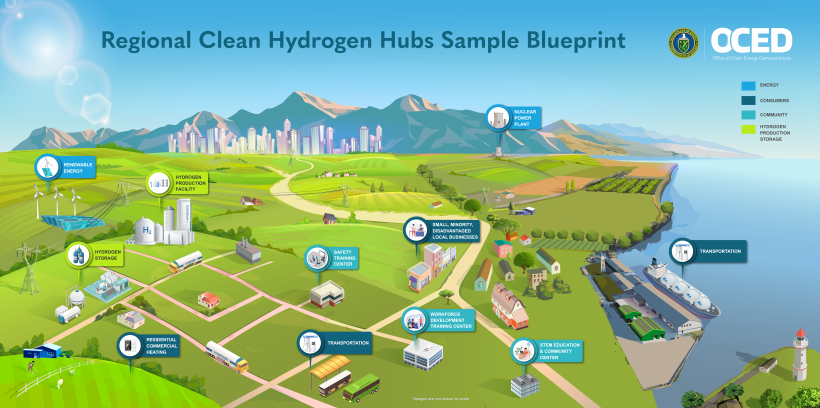
Regional Clean Hydrogen Hubs (H2Hubs) are networks of clean hydrogen producers, consumers, and connective infrastructure that will help accelerate the large-scale production and use of clean hydrogen. Funded by the Bipartisan Infrastructure Law (BIL), DOE is announcing $7 billion to jumpstart the hydrogen economy by establishing these H2Hubs, which will be met with the H2Hubs selectees’ cost share of more than $40 billion.
- Hydrogen Production: Together, the H2Hubs are expected to produce nearly 8,000 metric tons of hydrogen tons per day—equivalent to 3 million metric tons per year—which is nearly 30 percent of the U.S. National Clean Hydrogen Strategy and Roadmap’s goal of producing 10 million metric tons of clean hydrogen per year by 2030.
- Hydrogen Consumers/End-Users: H2Hubs end users include industrial use, including steel, synthetic fuel production and other uses; transportation, including fuel cell vehicles, maritime, heavy-duty transportation, and more; residential and commercial heating; and electric power generation, including energy storage and backup power.
- Connective Infrastructure: The H2Hubs will develop storage facilities, refueling stations, pipelines, and other necessary infrastructure to connect hydrogen production with its point of consumption.
In addition to these three key infrastructure elements, H2Hubs must also provide meaningful, tangible benefits to host communities and workers—for example through quality permanent jobs; reduction in air pollution; and equitable access to enterprise creation—so that all Americans can benefit from the clean hydrogen economy.