


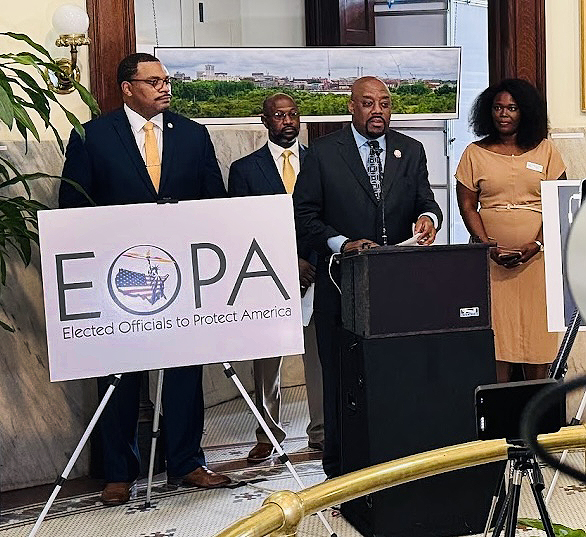
Commissioner Aaron “Adot” Whitely, District 6, Chatham County Board spoke about how environmental justice communities will be uplifted by federal funding. Back Row left to right: Savannah Mayor Van R. Johnson, II talked about the importance of his city’s climate plan Savannah 100 and how it’s being implemented with the assistance of federal funding from the Inflation Reduction Act (IRA) and other federal grants. Next to him is Christian Brock, CEO of Elected Officials to Protect America, Air Force Veteran, who hosted the event with the Climate Action Campaign, and right: Nicole Lee owner of Be Smart Home Solutions spoke about the work her company does with the city to help install solar panels and weatherize homes- with funds from the IRA.
$369 billion in IRA Tax Breaks and Incentives Help Mitigate the Climate Crisis — Put USA on the Road to a Clean Energy Economy
October 10, 2024
By Ramona du Houx
Savannah, Georgia. The Inflation Reduction Act (IRA) provides over $369 billion in tax breaks, incentives, grants, and loan guarantees that will help mitigate the climate crisis which is devastating communities daily with weather extremes and bad air quality. The southeast is still recovering from the impact from the veracity of Hurricane Helene that was unleashed. Too many lost their livelihoods and too many families lost a loved one. Although it had become a tropical storm when it hit Georgia, the Savannah area ended up in the path of strong Atlantic winds moving onshore unimpeded, resulting in destruction. That’s why measures the city is taking with 100% Savannah along with federal funding are key for the area’s future.
During a press conference at City Hall, Mayor Van R. Johnson II joined local leaders to showcase the city’s leadership in clean energy, sustainability, and climate action. Because of Mayor Van R. Johnson II’s stewardship Savannah is becoming the epicenter of climate resilience in the south. Savannah’s climate plan and equitable climate goals are being implemented with the help of Inflation Reduction Act (IRA) and Bipartisan Infrastructure Law (BIL) grants. As the city’s climate goals are being realized, Justice40 areas communities are being uplifted and environmental justice is taking root.
Please click HERE for the Youtube recording.
“We will achieve equitable clean energy for all,” said Savannah Mayor Van R. Johnson, II. “We are grateful to our federal and coalition partners for investing in our community-centered vision. Solar for All, retrofitting buildings, and transitioning to electric vehicles will improve economic growth, save taxpayers money, reduce carbon pollution, and improve the city’s air quality and public health. Additionally, our climate resiliency plan will give our residents confidence in the future. The resources we humbly receive are going to communities who need them the most, while creating jobs.”
Savannah is known nationally for its climate action work, and as such is a model for other cities. Yet no city can achieve the infrastructure changes needed on its own. This is where the IRA and BIL are key components to a sustainable future for all. With federal funding under President Biden’s Justice40 initiative the work of helping to clean up toxic pollution in the air, water and land that affects environmental justice and Justice40 communities disproportionately the most is underway.
“Savannah is a leader in advancing clean energy deployment, and implementing climate resilience plans. With solar power, and heat pumps that also cool, and electric stoves homeowners and businesses are seeing monthly utility costs go down while their quality of life goes up. The Inflation Reduction Act’s focus on retrofitting buildings, especially in Justice40 areas has jump-started this critical work,” said Christian Brock, CEO of Elected Officials to Protect America, Air Force Veteran. “Everyone has the right to breathe fresh air, drink clean water and grow up in an energy secure America. The Inflation Reduction Act will help us achieve environmental equality on the road to a clean energy economy.”
Speakers at the press conference discussed how Savannah’s efforts, including 100% Savannah, have enabled the city to more readily apply and receive the federal funding. The city’s comprehensive climate plan working with stakeholders and other municipalities set the stage.
The IRA offers opportunities that will help accelerate 100% Savannah initiated in March 2020, which aims to have all electricity consumed in the city provided by clean, safe and renewable sources by 2035.
The city has already installed rooftop solar at 19 city facilities and are poised to become the largest municipal power producer (by megawatt-hours) in Georgia.
“Savannah has become a model for an equitable transition to clean energy. We’re fortunate that federal funds have been allocated for us to help achieve our climate goals. Now, together with Chatham County, we’re investing $100 million to improve our drainage systems, including by widening canals, upgrading stormwater pumps and engineering dynamic solutions such as deep tunnel boring technologies 100 feet below ground to better conduct stormwater into the Casey Canal. With the Inflation Reduction Act we can rely on solar for more facilities throughout the city. It also provides workforce training and consumers are seeing energy savings,” said Alderman Nick Palumbo, District 4, Savannah. “These grant funding opportunities could unlock the possibility for other cities to utilize the same programs we are because the IRA has made the cost of implementation effective well into the future.”


The law provides grants and incentives for clean energy to local governments and nonprofits, which haven’t been able to take advantage of previous programs that offered only tax credits.
Importantly, the IRA is allocating 40 percent of its investments for Justice40 communities — improving environmental justice —bringing hope into communities historically neglected that are impacted by fossil fuel pollution and extreme weather the most. According to Treasury analysis, since the IRA passed, 75 percent of clean energy investments have been in counties with lower than median household incomes.
“100% Savannah aims to transition to clean, renewable energy by 2035 for electricity and 2050 for all other energy sources. The overall sustainability plan dramatically improves community health by cleaning the air and water of pollutants, and strengthening our climate resiliency,” said City Manager Joseph A. Melder, Savannah. “The Inflation Reduction Act and the Bipartisan Infrastructure Law are helping us enact climate justice because now we can afford to act accordingly.”
Along with other cities, Savannah is a member of The Georgia BRIGHT Communities Coalition, which this spring was awarded a $156 million Inflation Reduction Act grant through the Greenhouse Gas Reduction Fund’s Solar for All program. The Coalition’s grant will support investments in solar energy across the state for five years.
“The Inflation Reduction Act is a climate justice law which was enacted in the nick of time. We don’t need a hurricane to remind the residents of our County that extreme weather events are a clear and present danger. Roads and businesses are closed on a regular basis, causing disruption and havoc to lives and livelihoods,” said Commissioner Aaron “Adot” Whitely, District 6, Chatham County Board. “We are building the infrastructure needed to protect Chatham County from the constant climate crisis threat of flooding and erosion with the help of the IRA and Bipartisan Infrastructure Law. Federal support is providing us with the resources needed to transition to clean energy. Currently there are vulnerable communities without power due to this recent storm, with the help of federal funding we can create a level of resilience for everyone as it continues to cut costs for families, creates jobs, boosts local clean energy goals, and helps build county defenses against coastal flooding.”
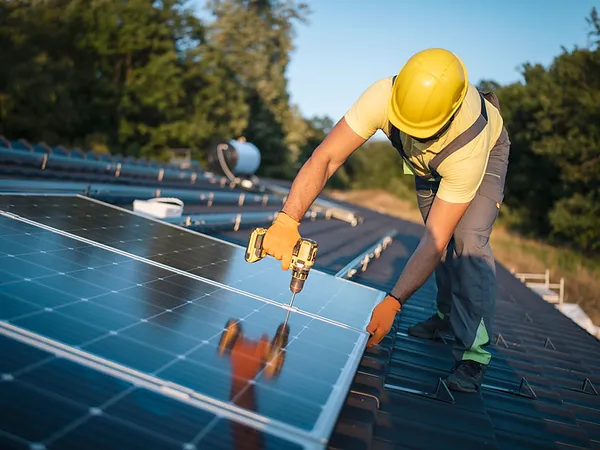
Solar for All is a $7 billion competitive grant program administered by the EPA and funded by the Inflation Reduction Act. The EPA has awarded 60 grants to states, territories, tribal governments, municipalities, and nonprofits to bring the benefits of solar energy to low-income and disadvantaged communities.
Tax credits covering 30 percent of the costs of community solar projects — owned by local businesses that sign up families to save on their electric bills — with additional bonus credits of 20 percent for projects at affordable housing properties and 10 percent for projects in low-income communities.
“Our clients have seen substantial savings on their energy bills thanks to solar installations through the Georgia Bright Program. With the recent utility rate increase, these savings are even more significant. Many of our customers are also taking advantage of the Inflation Reduction Act rebates to further reduce their energy cost through energy-efficient home improvements,” said Nicole Lee of Be Smart Home Solutions.
A Treasury analysis shows that in 2023, more than 3.4 million American families benefited from $8.4 billion in tax credits to lower the costs of clean energy and energy efficiency upgrades to their homes. Tax credits covering 30 percent of the costs to install solar panels and battery storage systems, make home improvements that reduce energy leakage, or upgrade heating and cooling equipment.
Georgia is home to 1.1 million small businesses, representing 99.6 percent of all businesses in the state. The Inflation Reduction Act helps them save money. Commercial building owners can receive a tax credit up to $5 per square foot to support energy efficiency improvements that deliver lower utility bills.
“Mayor Van R. Johnson II is making his city a model of climate resiliency for the southeast.with 100% Savannah and the assistance of the Inflation Reduction Act as it reduces our carbon footprint, creates jobs, lifts up Justice40 communities, and helps public health and energy security,” said Alex Cornell du Houx, former Maine State Representative, Marine combat veteran, President of the Elected Officials to Protect America, and Co-Founder. “The IRA has been the catalyst that has put America on the road to a clean energy economy while growing good paying jobs with a credit for manufacturers and installers that multiplies up to fivefold if the employer meets prevailing wage requirements and apprenticeship requirements.”
According to American Clean Power, 113 manufacturing facilities or expansions have been announced since August 2022, totaling $421 billion of investment in domestic, utility-scale clean energy production, as of spring this year.
Some other progress since the Inflation Reduction Act became law:
- Since the IRA passed the certainty that the law provides has led the private sector to announce more than $265 billion of that investment creating more than 300,000 jobs
- Since January 2024, more than 250,000 Americans have claimed the IRA’s electric vehicle tax credits, saving about $1.5 billion total. Nearly all of these buyers claimed the incentive at the point of sale. EV upfront discounts are up to $7,500 for new EVs and $4,000 for used EVs. A record 1.2 million EVs were sold in the U.S. in 2023, representing 7.6 percent of total vehicle sales, up from 5.9 percent in 2022.
- Companies have already announced enough new U.S. battery manufacturing projects to support production of more than 10 million EVs per year
- A record 31 gigawatts (GW) of solar energy capacity was installed in the U.S. in 2023, a roughly 55 percent increase.
- Projections call for an uptick of new land wind projects this year, totaling about 17 GW in 2024 alone.
- Together, renewables combined with energy storage dominated new utility-scale generation sources, representing more than three-quarters of total new capacity added. Renewables, including large hydropower, represented about 25 percent of electricity generated in the United States in the first half of 2023.