


Funded by President Biden’s Investing in America Agenda, EPA announces 25 selected applications through competitive Climate Pollution Reduction Grants program to tackle climate change, improve air quality, and advance environmental justice
July 23, 2024
WASHINGTON – On July 22, as part of the Biden-Harris Administration’s Investing in America agenda, the U.S. Environmental Protection Agency announced selected recipients of over $4.3 billion in Climate Pollution Reduction Grants to implement community-driven solutions that tackle the climate crisis, reduce air pollution, advance environmental justice, and accelerate America’s clean energy transition.
When estimates provided by all selected applicants are combined, the proposed projects would reduce greenhouse gas pollution by as much as 971 million metric tons of carbon dioxide equivalent by 2050, roughly the emissions from 5 million average homes’ energy use each year for over 25 years
The 25 selected applications will fund projects in 30 states, including one Tribe, that target reducing greenhouse gas pollution from six sectors: transportation, electric power, commercial and residential buildings, industry, agriculture/ natural and working lands, and waste and materials management. In addition to today’s selected applications for specific projects, this first-of-its kind program secured by President Biden’s Inflation Reduction Act is also helping 45 states and dozens of metro areas, Tribes and territories develop Climate Action Plans and is the single largest effort to spur the development of concrete local climate action goals across the nation.
The grants will fund projects supporting the deployment of technologies and programs to reduce greenhouse gases and other harmful pollution across the country and build the infrastructure, housing, industry, and competitive economy needed for a clean energy future. These grants will also help businesses capitalize on new opportunities, spur economic growth and job creation in new and growing industries, and support development of training programs to prepare workers.
Together, these selected projects will implement ambitious climate pollution reduction measures designed by states, Tribes and local governments that will achieve significant cumulative GHG reductions by 2030 and beyond. When estimates provided by all selected applicants are combined, the proposed projects would reduce greenhouse gas pollution by as much as 971 million metric tons of carbon dioxide equivalent by 2050, roughly the emissions from 5 million average homes’ energy use each year for over 25 years.
EPA expects to announce up to an additional $300 million in selections under the Climate Pollution Reduction Grants program for Tribes, Tribal consortia, and territories later this summer.
EPA Administrator Michael S. Regan announced selections in Pittsburgh, Pennsylvania with Governor Josh Shapiro as part of the Biden-Harris Administration’s fifth Investing in America tour.
“President Biden believes in the power of community-driven solutions to fight climate change, protect public health, and grow our economy. Thanks to his leadership, the Climate Pollution Reduction Grants program will deliver unprecedented resources to states, local governments, and Tribes to fund the solutions that work best in their communities,” said EPA Administrator Michael S. Regan. “Selected recipients have put forward ambitious plans to advance sustainable agriculture, deploy clean industrial technologies, cut emissions and energy costs in homes and commercial buildings, and provide cost- and energy-efficient heating and cooling to communities, creating economic and workforce development opportunities along the way.”
Pennsylvania’s Department of Environmental Protection has been selected to receive a more than $396 million grant for their proposed RISE PA project which will reduce industrial GHG emissions in the industrial sector through a competitive grants program and incentives for small-, medium- and large-scale decarbonization projects across the state.
“President Biden’s Climate Pollution Reduction Grants put local governments in the driver’s seat to develop climate solutions that work for their communities,” said John Podesta, Senior Advisor to the President for International Climate Policy. “These grants will help state and local governments improve the air quality and health of their communities, while accelerating America’s progress toward our climate goals.”
EPA senior leadership will also join Senator Alex Padilla (CA) and officials to announce that the South Coast Air Quality Management District has been selected to receive nearly $500 million for transportation and freight decarbonization through incentives for electric charging equipment and zero-emission freight vehicles.
“My Administration is taking real action to address climate change while continuing to create energy jobs and grow the economy – and today, I’m proud to announce that thanks to our partnership with the Biden Administration, Pennsylvania has been awarded $396 million in federal funding to start a new initiative called RISE PA,” said Governor Josh Shapiro. “This is one of the largest federal grants Pennsylvania has ever received, and through RISE PA, we will offer grants for companies working to make their operations more efficient. This investment will help us reduce toxic air pollution, create thousands of jobs, invest in our energy sector, and continue Pennsylvania’s legacy of energy leadership.”
EPA made its selections through a rigorous grants competition that was designed to be fair and impartial. The Agency reviewed nearly 300 applications that were submitted by entities from across the country and requested a total of nearly $33 billion in funding.
“Under President Biden’s leadership, this Administration has mobilized every tool and resource to reduce climate pollution, advance environmental justice, and spark economic growth in communities across America, and today’s transformational investments will further empower Governors and Mayors to seize these opportunities,” said White House National Climate Advisor Ali Zaidi. “As part of President Biden’s historic climate laws, today’s funding announcement for locally led projects will support community priorities while animating a race to the top on climate jobs. These awards will supercharge American climate progress across sectors – from reaching 100% clean electricity to slashing super-pollutants like methane to harnessing the power of nature across our farms and forests in the fight against climate change. This is a big deal.”
The 25 selected applications – from states, a Tribe, local governments, and coalitions of these entities – will receive federal funding to implement local and regional solutions. Many of these projects can be expanded and provide examples that other states, local governments, Tribes, and even businesses can replicate in their work to tackle the climate crisis. For example:
- The Montana Forest, Community and Working Landscapes Climate Resiliency Project will fund measures that improve forest management and expand urban and community forests. The selected application will also assist efforts to mitigate wildfires and coal seam fires and support local initiatives to improve soil health and reduce pollution from agriculture.
- The Nebraska Department of Environment and Energy will fund measures to increase the adoption of climate-smart and precision agriculture and reduce agricultural waste from livestock. The selected application will also fund projects to improve energy efficiency in commercial and industrial facilities and low-income households as well as deploy solar and electrify irrigation wells.
- The Clean Corridor Coalition’s proposal for ZE-MHDV Infrastructure along the I-95 Corridor project will deploy electric vehicle charging infrastructure for commercial zero-emission medium- and heavy-duty vehicles on the Interstate-95 freight corridor. This is a joint venture amongst the New Jersey Department of Environmental Protection, Connecticut Department of Energy and Environmental Protection, Delaware Department of Transportation, and Maryland Departments of the Environment and Transportation. The selected application will provide technical assistance for workforce development and corridor planning across New Jersey, Connecticut, Delaware, and Maryland.
- The Accelerating Siting, Zoning, and Permitting of 60 percent Renewable Energy in Michigan grant will provide incentives and technical assistance to local and Tribal governments to accelerate the siting, zoning, and permitting of renewable energy. The selected application will help spur the adoption of renewable energy at the scale and pace needed to reach Michigan’s goal of 60 percent renewable energy by 2030.
- The Atlantic Conservation Coalition is a regional approach focused on natural climate solutions to reduce greenhouse gas emissions. The selected application will fund efforts across North Carolina, South Carolina, Maryland, and Virginia to leverage the carbon sequestration power of natural and working lands, including coastal wetlands, peatlands, forests, and urban forestry. The Atlantic Conservation Coalition is a partnership amongst the North Carolina Department of Natural and Cultural Resources, South Carolina Office of Resilience, Maryland Department of the Environment, and Virginia Department of Environmental Quality 1.
- The Accelerating Clean Energy Savings in Alaska’s Coastal Communities grant will provide advisory services and incentives to replace residential oil burning systems with energy-efficient heat pumps in 50 Alaskan communities.
State, Tribal and local action is vital to deliver on the President’s commitment to reduce climate pollution by over 50% by 2030 and achieve net-zero emissions no later than 2050. The innovative measures contained in the selected applications, developed with input from local communities, are expected to achieve substantial public health benefits such as reducing exposure to extreme heat, improving air quality, reducing energy burden for lower income Americans, improving climate resilience, and providing workforce and economic development opportunities, particularly in low-income and disadvantaged communities.
The Climate Pollution Reduction Grants advance President Biden’s historic Justice40 Initiative, which aims to ensure 40 percent of the overall benefits of certain climate, clean energy, and other federal investments flow to disadvantaged communities that are marginalized by underinvestment and overburdened by pollution. EPA expects to award the funds later this year, once all legal and administrative requirements are satisfied.
Many of the proposed projects contained in the selected applications announced today, as well as the $250 million in planning grant funding that EPA is providing under the CPRG program for development of Climate Action Plans by state, local, and Tribal governments across the country, will complement the Biden-Harris Administration’s historic federal actions and national climate strategies across sectors. Those include: the U.S. National Blueprint for Transportation Decarbonization, the Administration’s efforts to achieve 100 percent clean electricity by 2035 and make zero emissions construction common practice by 2030, the Industrial Decarbonization Roadmap, the U.S. Buildings Decarbonization Blueprint, the Administration’s climate-smart agriculture efforts and Nature Based Solutions Roadmap, the U.S. Methane Emissions Reduction Action Plan, the National Climate Resilience Framework, and more.
Learn more about the selected applications
Learn more about the CPRG program
NOAA’s Climate-Ready Coasts initiative advances climate solutions for coastal communities
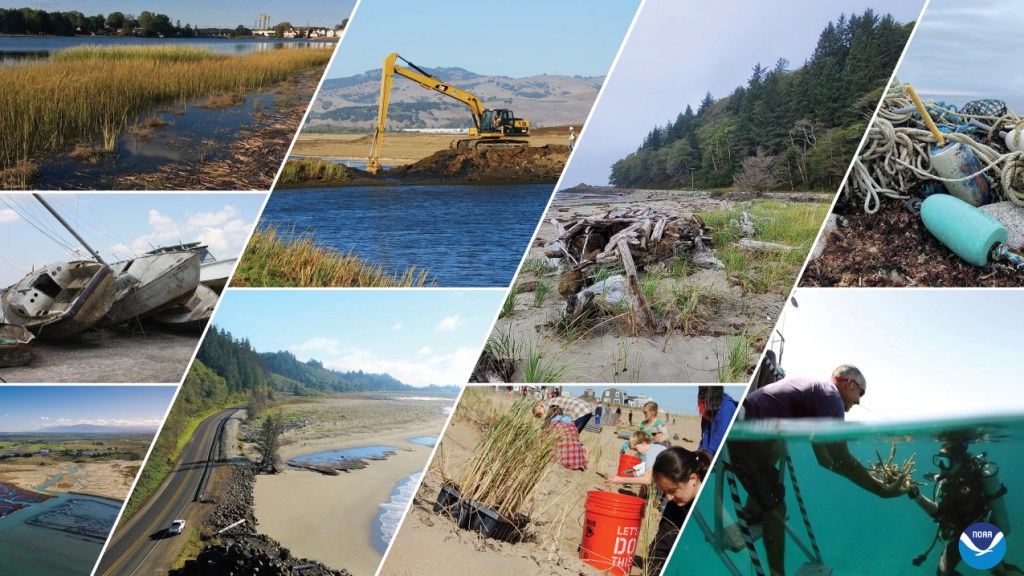
NOAA announced approximately $562 million in recommended funding to support the Climate-Ready Coasts initiative:
- $477 million for high-impact projects that create climate solutions by strengthening coastal communities’ ability to respond to extreme weather events, pollution and marine debris; restoring coastal habitats to help wildlife and humans thrive; storing carbon; building the capacity of underserved communities to address climate hazards and supporting community-driven restoration; and creating jobs in local communities.
- $46 million in additional funding through the National Fish and Wildlife Foundation National Coastal Resilience Fund for projects that will help communities prepare for increasing coastal flooding, sea-level rise and more intense storms, while improving thousands of acres of coastal habitats.
- $39.1 million in non-competitive funding to the 34 state and territorial coastal management programs and 30 national estuarine research reserves that work in partnership with NOAA under the Coastal Zone Management Act. Funding for these programs provides essential planning, policy development and implementation, research, education, and collaborative engagement with communities around the nation to protect coastal and estuarine ecosystems important for the resilience of coastal economies and the health of coastal environments.
Demand for funding focused on preparing for and adapting to climate change is high. In the first year, NOAA’s BIL Climate-Ready Coasts far exceeded the funding available. In response to this high demand, NOAA is leveraging these requests with funding from President Biden’s Inflation Reduction Act, allowing more high-quality projects to be recommended for funding and move forward.
“This crucial federal investment will help coastal communities in every corner of the Empire State, from the shores of Lake Ontario to the Hudson River, tackle the climate crisis by cleaning our waterways and bolstering critical infrastructure — all while putting New Yorkers to work and boosting our economy,” said Senate Majority Leader Schumer. “When I led the Bipartisan Infrastructure Law and the Inflation Reduction Act to passage as Majority Leader, it was game changing investments in climate ready initiatives like these that I had in mind. From Long Island to Buffalo, I am proud to support communities across New York in leading the fight against climate change and building the a cleaner more resilient future for the next generation.”
“Thanks to the Biden-Harris Infrastructure Law and the Inflation Reduction Act, these grants will ensure that coastal communities across the United States will have the tools and resources to withstand the effects of climate change,” said Senate Commerce, Science and Transportation Committee Chair Cantwell. “These historic grants will support 149 projects aimed at coastal restoration and resilience projects in 30 coastal states and territories, including in the State of Washington, to restore ecosystems, recover species, and support community-driven conservation projects.”
“NOAA has a long history of working with community partners to advance our understanding of coastal processes, conserve coastal resources and restore habitat in ways that benefit wildlife, people, and the economy,” said NOAA Administrator Rick Spinrad, Ph.D. “Funding through the President’s Investing in America agenda allows us to super-charge these activities so that communities, including Tribal governments, facing all types of climate impacts can prepare for what’s ahead, create climate-smart jobs and build economic resilience, and ultimately thrive.”
Information on the 149 Climate-Ready Coasts natural infrastructure projects recommended for funding are listed by state and U.S. territory at the links below.
- Alabama
- Alaska
- American Samoa
- California – Northern
- California – Southern
- Commonwealth of the Northern Mariana Islands and Freely Associated States
- Delaware
- Florida
- Georgia