

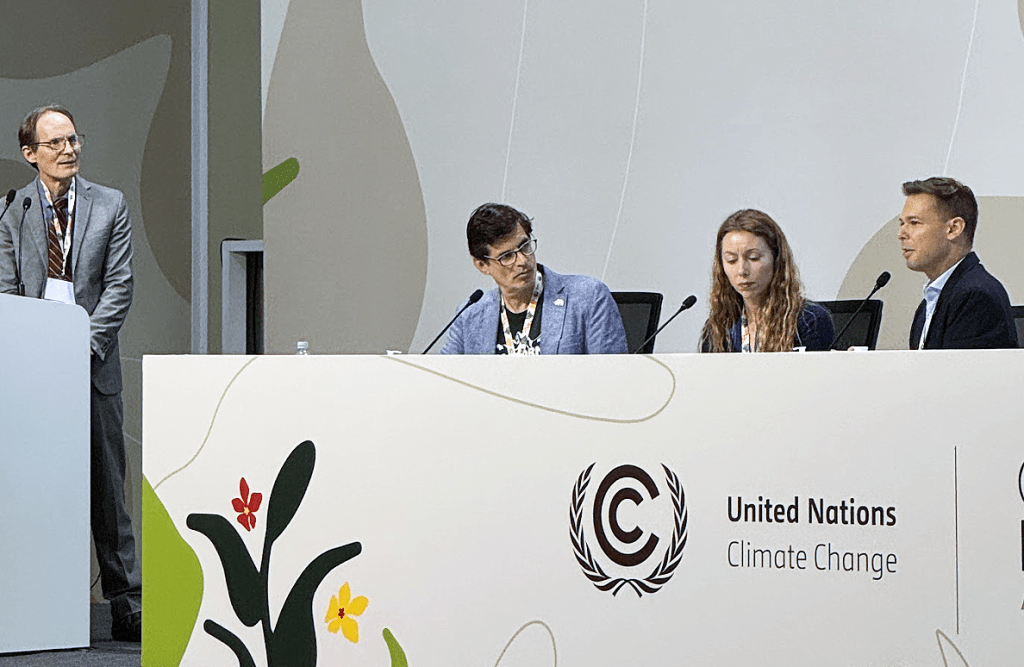
Photo left to right: The press conference moderated by Barry Vesser, Chief Operations Officer of The Climate Center, California State Senator Josh Becker, 13th Senate District, Lynda Hopkins, Supervisor Somona County, California, Chair of the Bay Area Air District, and Alex Cornell du Houx, former Maine State Representative, Marine combat veteran, President of the Elected Officials to Protect America (EOPA), and Co-Founder.
Clean energy investments have taken root in states despite current administration
By Ramona du Houx
November 13, 2025
Belém, Brazil. At the United Nations Climate Change Conference (COP30) in Belém, Brazil, US elected officials spoke about the importance of continuing to implement clean energy solutions at the state and local levels during the current administration. They emphasized that clean energy projects are moving forward in US cities and states despite an all-out assault from the current administration on clean energy.
What state and local governments in the US do to address the climate crisis matters. California is the world’s 4th largest economy, and New York is the 10th. Their policies along with other states can give direction for others to follow.
“As these and other states make progress implementing clean energy climate policies, they are showing the federal government that the transition to clean energy cannot be stopped. They have already shown that clean energy is cheaper to implement than polluting fossil fuels and that these investments have been responsible for economic growth,” said Barry Vesser, Chief Program Officer of The Climate Center.
According to the International Renewable Energy Agency, renewables are the cheapest form of power today.
In 2023, California was powered by two-thirds clean energy, making it the largest economy in the world to achieve this level. The state has also run on 100 percent clean electricity for part of the day almost every day in 2025.
“I’m proud to have helped pass California’s most ambitious energy affordability bill in decades, delivering billions in savings for Californians while strengthening grid reliability and accelerating clean energy,” said California State Senator Josh Becker, 13th Senate District. “This landmark law will deliver for every corner of the Golden State on energy affordability, as well as wildfire mitigation and relief, and will help fast-track California’s transition to clean energy. We are moving forward, and I hope other states follow our lead.”
Even small states like Maine, with 1.3 million people, are stepping up on a big scale. Maine is a leader in energy efficiency policy and programs, with a recent scorecard placing the state tenth in the nation for the most energy-efficient economy. Maine set statutory goals in 2011 to cut oil consumption by 30 percent from 2007 levels by 2030 and at least 50 percent by 2050. The state has already surpassed the 2030 target and is on track to meet the 2050 goal.
The number of clean energy jobs in Maine reached nearly 15,600 in 2023, with energy efficiency jobs making up more than half of those positions. Currently, Maine has nearly 700 registered heat pump installers.
“In 2024, the portion of Maine households reliant on heating oil fell to 50 percent, a testament to the state’s record adoption of high-efficiency heat pumps. While we will lose the tax benefits provided by the previous administration, our state will continue its own energy efficiency rebates,” said Alex Cornell du Houx, former Maine State Representative, Marine combat veteran, President of the Elected Officials to Protect America, and Co-Founder. The war in Ukraine is a clear warning to the world, illustrating how dependency on a single source of energy creates instability and funds fossil fuel dictators like Putin. Alternatively, distributed clean energy is secure, costs less, and creates prosperity. A clean energy future is an energy secure future.”
Expanded climate action from cities and states, paired with federal re-engagement after 2028, could by 2035 slash US planet-heating pollution by up to 56 percent, putting the United States below 2005 levels, according to a new study from America Is All In and the University of Maryland’s Center for Global Sustainability.
“We will not allow our country to become numb or debilitated by those who are standing in the way of progress,” said Gina McCarthy, the former Environmental Protection Agency Director, on a press call ahead of COP30.
McCarthy co-chairs America Is All In, a coalition of climate-concerned states and cities in the US. The group sent more than 100 US subnational leaders – including governors, senior state officials, nearly 40 mayors, and dozens of city officials – to the UN Local Leaders Forum in Rio de Janeiro the week before COP30 got underway.